
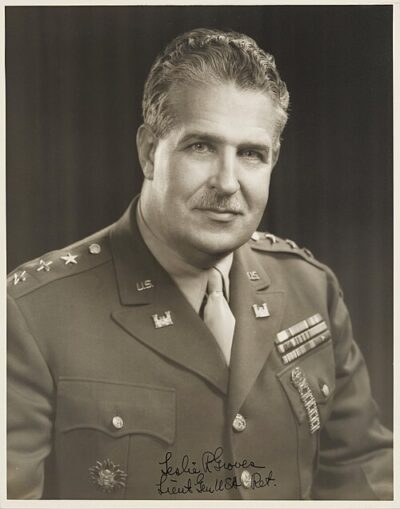
Leslie Groves
Leslie Groves was an United States Army Corps of Engineers officer. Born August 17, 1896, in Albany. Died July 13, 1970, in Washington, D.C.. Educated at United States Army Command and General Staff College and United States Military Academy. Awards include Legionnaire of Legion of Merit, Distinguished Service Medal and World War I Victory Medal (United States).
Facts
26 facts · 2 confirmed by two sources · 7 cited · 17 from one source
Where this comes from
Papalocal keeps its own record. It started from these sources; what each one said is kept here as it was copied, so a change on their side never changes this page by itself. Tap one to read its version.
What Wikidata says · copied November 13, 2026 · revision 2564367752
- Described as
- United States Army Corps of Engineers officer (1896–1970)
- Other names
- Leslie R. Groves, Lieutenant General Leslie Richard Groves, Jr., Leslie Richard Groves, L. R. Groves
- Born
- August 17, 1896 · 4 references
- Died
- July 13, 1970 · 4 references
- Born in
- Albany
- Died in
- Washington, D.C.
- Buried in
- Arlington National Cemetery (1970) · 1 reference
- Cause of death
- myocardial infarction
- Name at birth
- Leslie Richard Groves
- Citizen of
- United States
- Occupation
- military engineer; army officer
- Education
- United States Army Command and General Staff College (–1936) · 1 reference; United States Military Academy (–1918) · 2 references; United States Army War College (–1939) · 1 reference; Queen Anne High School (–1914); Engineer Officer Basic Course (–1921) · 1 reference; University of Washington
- Awards
- Legionnaire of Legion of Merit · 1 reference; Distinguished Service Medal · 1 reference; World War I Victory Medal (United States) · 1 reference; Army of Occupation of Germany Medal · 1 reference; American Campaign Medal · 1 reference; World War II Victory Medal · 1 reference; Army Staff Identification Badge · 1 reference
- Military branch
- military engineering · 1 reference
- Military rank
- lieutenant general (1948–) · 1 reference; general · 1 reference
- Wikipedias with a page
- 42
Wikidata item Q314675 (wikidata.org/wiki/Q314675), public domain (CC0). Copied November 13, 2026.
What Wikipedia says · copied November 13, 2026 · revision 1383901697
Leslie Richard Groves Jr. (17 August 1896 – 13 July 1970) was a United States Army Corps of Engineers officer. He oversaw the construction of the Pentagon and directed the Manhattan Project, the top secret research program that developed the atomic bomb during World War II, leading to the atomic bombings of Hiroshima and Nagasaki in 1945.
The son of a U.S. Army chaplain, Groves lived at various Army posts during his childhood. In 1918, he graduated fourth in his class at the United States Military Academy at West Point and was commissioned into the United States Army Corps of Engineers. In 1929, he went to Nicaragua as part of an expedition to conduct a survey for the Inter-Oceanic Nicaragua Canal. Following the 1931 Nicaraguan earthquake, Groves took over Managua's water supply system, for which he was awarded the Nicaraguan Presidential Medal of Merit. He attended the Command and General Staff School at Fort Leavenworth, Kansas, in 1935 and 1936, and the Army War College in 1938 and 1939, after which he was posted to the War Department General Staff. Groves developed "a reputation as a doer, a driver, and a stickler for duty". In 1940 he became special assistant for construction to the Quartermaster General, tasked with inspecting construction sites and checking on their progress. In August 1941, he was appointed to create the gigantic office complex for the War Department's 40,000 staff that would ultimately become the Pentagon.
In September 1942, Groves took charge of the Manhattan Project. He was involved in most aspects of the atomic bomb's development: he participated in the selection of sites for research and production at Oak Ridge, Tennessee; Los Alamos, New Mexico; and Hanford, Washington. He directed the enormous construction effort, made critical decisions on the various methods of isotope separation, acquired raw materials, directed the collection of military intelligence on the German nuclear energy project and helped select the cities in Japan that were chosen as targets. Groves wrapped the Manhattan Project in security, but spies working within the project were able to pass some of its most important secrets to the Soviet Union.
After the war, Groves remained in charge of the Manhattan Project until responsibility for nuclear weapons production was handed over to the United States Atomic Energy Commission in 1947. He then headed the Armed Forces Special Weapons Project, which had been created to control the military aspects of nuclear weapons. He was given a dressing down by the Chief of Staff of the Army, General of the Army Dwight D. Eisenhower, on the basis of various complaints, and told that he would never be appointed Chief of Engineers. Three days later, Groves announced his intention to leave the Army. He was promoted to lieutenant general just before his retirement on 29 February 1948 in recognition of his leadership of the bomb program. By a special act of Congress, his date of rank was backdated to 16 July 1945, the date of the Trinity nuclear test. He went on to become a vice president at Sperry Rand.
- Born, in its opening lines
- August 17, 1896
- Died, in its opening lines
- July 13, 1970
From the Wikipedia article “Leslie Groves” (en.wikipedia.org/wiki/Leslie_Groves), by its contributors, under CC BY-SA 4.0 (creativecommons.org/licenses/by-sa/4.0/). Copied November 13, 2026; not changed.
Confirmed Two sources agree. Cited One source, and it names where it got it. One source One source, without a reference of its own. Sources disagree The sources disagree. We show the best-supported value and keep theirs below.
