
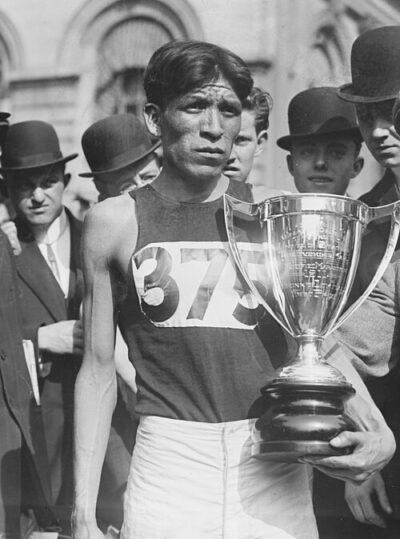
Lewis Tewanima was an athletics competitor. Born 1888, in Shongopovi. Died January 18, 1969, in Second Mesa. Educated at Carlisle Indian Industrial School.
Facts
10 facts · 2 confirmed by two sources · 2 cited · 6 from one source
Where this comes from
Papalocal keeps its own record. It started from these sources; what each one said is kept here as it was copied, so a change on their side never changes this page by itself. Tap one to read its version.
What Wikidata says · copied November 18, 2026 · revision 2550419920
- Described as
- athletics competitor (1888–1969)
- Other names
- Louis Tewanima, Tsökahovi Tewanima, Louis Tawanima
- Born
- 1888 · 1 reference
- Died
- January 18, 1969
- Born in
- Shongopovi · 1 reference
- Died in
- Second Mesa · 1 reference
- Citizen of
- United States
- Occupation
- athletics competitor; marathon runner · 1 reference
- Education
- Carlisle Indian Industrial School
- Sport
- athletics
- Height
- 1.60 m (5 ft 3 in) · 1 reference
- Wikipedias with a page
- 18
Wikidata item Q1761766 (wikidata.org/wiki/Q1761766), public domain (CC0). Copied November 18, 2026.
What Wikipedia says · copied November 18, 2026 · revision 1382317975
Louis Tewanima (1888 – January 18, 1969), also known as Tsökahovi Tewanima and Lewis Tewanima, was an American two-time Olympic distance runner and silver medalist in the 10,000 meter run in 1912. He was a Hopi Indian and ran for the Carlisle Indian School where he was a teammate of Jim Thorpe. His silver medal in 1912 remained the best U.S. achievement in this event until another Native American, Billy Mills, won the gold medal in 1964. Tewanima also competed at the 1908 Olympics, finishing in ninth place in the marathon.
- Born, in its opening lines
- 1888
- Died, in its opening lines
- January 18, 1969
From the Wikipedia article “Lewis Tewanima” (en.wikipedia.org/wiki/Lewis_Tewanima), by its contributors, under CC BY-SA 4.0 (creativecommons.org/licenses/by-sa/4.0/). Copied November 18, 2026; not changed.
Confirmed Two sources agree. Cited One source, and it names where it got it. One source One source, without a reference of its own. Sources disagree The sources disagree. We show the best-supported value and keep theirs below.
