
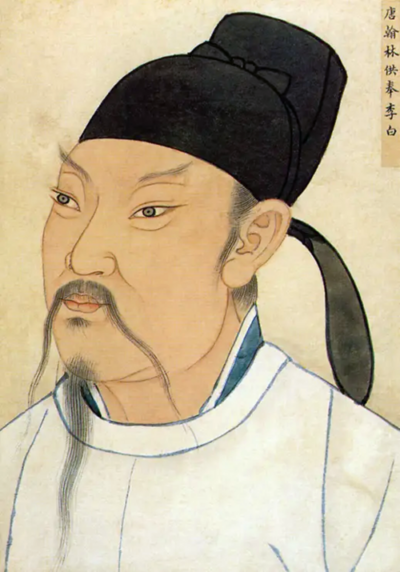
Li Bai
Li Bai was a Classical Chinese poet of the Tang dynasty. Born May 19, 701, in Suyab. Died November 30, 762, in Dangtu County. Known for Quiet Night Thought, Mountain Q&A and Bringing in the Wine.
Facts
22 facts · 2 confirmed by two sources · 6 cited · 13 from one source · 1 where the sources disagree
What’s different
- Born in: we show Suyab (Sources disagree). Wikidata also lists Jiangyou
Where this comes from
Papalocal keeps its own record. It started from these sources; what each one said is kept here as it was copied, so a change on their side never changes this page by itself. Tap one to read its version.
What Wikidata says · copied November 16, 2026 · revision 2563893562
- Described as
- Classical Chinese poet of the Tang dynasty (701–762)
- Other names
- Li Bei, Taibai, Li T'ai-pai, Tai Pai, Li Pai, T'ai-pai, Tai-pai, Li Po, Li Taibai, T'ai Pai, Li Tai-pai, Li Bo
- Born
- May 19, 701 · 2 references
- Died
- November 30, 762 · 2 references
- Born in
- Suyab; Jiangyou
- Died in
- Dangtu County
- Buried in
- Tomb of Li Bai
- Cause of death
- drowning
- Name at birth
- 李白 · 1 reference
- Citizen of
- Tang dynasty · 1 reference
- Occupation
- poet · 1 reference; lyricist; calligrapher; writer · 1 reference; philosopher · 1 reference
- Member of
- Eight Immortals of the Wine Cup
- Known for
- Quiet Night Thought; Mountain Q&A; Bringing in the Wine; A Farewell to Meng Haoran on his Way to Yangzhou; A Farewell to a Friend; Departing from Baidi in the Morning
- Children
- Li Boqin · 1 reference
- Father
- Li Ke
- Wikipedias with a page
- 199
Wikidata item Q7071 (wikidata.org/wiki/Q7071), public domain (CC0). Copied November 16, 2026.
What Wikipedia says · copied November 16, 2026 · revision 1385686899
Li Bai (c. 701 – 762), also known by his courtesy name of Taibai, was a Chinese poet acclaimed as one of the best and most important poets of the Tang dynasty, and even in the whole of Chinese poetry. He and his friends such as Du Fu (712–770) were among the prominent figures in the flourishing of Chinese poetry of the Tang dynasty, often called the "Golden Age of Chinese Poetry". The expression "Three Wonders" denotes Li Bai's poetry, Pei Min's swordplay, and Zhang Xu's calligraphy.
Around 1,000 poems attributed to Li are extant. His poems have been collected into the most important Tang dynasty collection, Heyue yingling ji, compiled in 753 by Yin Fan. Thirty-four of Li Bai's poems are included in the anthology Three Hundred Tang Poems, which was first published in the 18th century. Around the same time, translations of his poems began to appear in Europe. In Ezra Pound's famous work Cathay (1915), Li Bai's poems enjoy the lion's share (11 out of 19).
Li Bai's poems became models for celebrating the pleasures of friendship, the depth of nature, solitude, and the joys of drinking. Among the most famous are "Waking from Drunkenness on a Spring Day" (春日醉起言志), "The Hard Road to Shu" (蜀道難), "Bring in the Wine" (將進酒), and "Quiet Night Thought", which are still taught in schools in China. In the West, multilingual translations of Li's poems continue to be made. His life has even taken on a legendary aspect, including tales of drunkenness and chivalry, and the well-known tale that Li drowned when he reached from his boat to grasp the moon's reflection in the river while he was drunk.
Much of Li's life is reflected in his poems, which are about places he visited; friends whom he saw off on journeys to distant locations, perhaps never to meet again; his own dream-like imaginings, embroidered with shamanic overtones; current events of which he had news; descriptions of nature, perceived as if in a timeless moment; and more. However, of particular importance are the changes in China during his lifetime. His early poems were written in a "golden age" of internal peace and prosperity, under an emperor who actively promoted and participated in the arts. This ended with the beginning of the rebellion of general An Lushan, which eventually left most of Northern China devastated by war and famine. Li's poems during this period take on new tones and qualities. Unlike his younger friend Du Fu, Li did not live to see the end of the chaos. Li Bai is depicted in the Wu Shuang Pu (无双谱; 無雙譜; 'Table of Peerless Heroes') by Jin Guliang.
- Born, in its opening lines
- 701
- Died, in its opening lines
- 762
From the Wikipedia article “Li Bai” (en.wikipedia.org/wiki/Li_Bai), by its contributors, under CC BY-SA 4.0 (creativecommons.org/licenses/by-sa/4.0/). Copied November 16, 2026; not changed.
Confirmed Two sources agree. Cited One source, and it names where it got it. One source One source, without a reference of its own. Sources disagree The sources disagree. We show the best-supported value and keep theirs below.
