
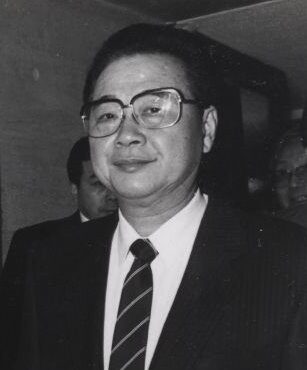
Li Peng
Li Peng was the 4th Premier of the People's Republic of China. Born October 20, 1928, in Shanghai. Died July 22, 2019, in Beijing. Positions held include Premier of the People's Republic of China (1988–1998), Chairman of the Standing Committee of the National People's Congress (1998–2003) and Vice Premier of the State Council of the People's Republic of China (1983–1987). Educated at Moscow Power Engineering Institute. Awards include Grand Cross of the Order of the Sun of Peru, Pushkin Medal and Nishan-e-Pakistan.
Facts
29 facts · 2 confirmed by two sources · 6 cited · 21 from one source
Where this comes from
Papalocal keeps its own record. It started from these sources; what each one said is kept here as it was copied, so a change on their side never changes this page by itself. Tap one to read its version.
What Wikidata says · copied November 16, 2026 · revision 2569074174
- Described as
- 4th Premier of the People's Republic of China (1928–2019)
- Other names
- 李鹏总理
- Born
- October 20, 1928 · 6 references
- Died
- July 22, 2019 · 4 references
- Born in
- Shanghai · 2 references
- Died in
- Beijing · 2 references
- Buried in
- Babaoshan Revolutionary Cemetery
- Cause of death
- disease
- Citizen of
- Republic of China (–1949); People's Republic of China (1949–)
- Occupation
- politician · 1 reference
- Positions held
- Premier of the People's Republic of China (1988–1998); Chairman of the Standing Committee of the National People's Congress (1998–2003); Vice Premier of the State Council of the People's Republic of China (1983–1987); member of the Politburo of the Chinese Communist Party (1985–2002); National People's Congress deputy; Minister of Education of the People's Republic of China; member of the Politburo Standing Committee of the Chinese Communist Party (1987–2002)
- Political party
- Chinese Communist Party (1945–2019) · 1 reference
- Education
- Moscow Power Engineering Institute (–1954)
- Awards
- Grand Cross of the Order of the Sun of Peru; Pushkin Medal (2007) · 1 reference; Nishan-e-Pakistan · 1 reference; Order of the Yugoslavian Great Star · 1 reference
- Spouse
- Zhu Lin (1958–2019) · 1 reference
- Children
- Li Xiaopeng; Li Xiaolin; Li Xiaoyong
- Father
- Li Shuoxun · 1 reference
- Mother
- Zhao Juntao
- Religion
- atheism
- Wikipedias with a page
- 56
Wikidata item Q18301 (wikidata.org/wiki/Q18301), public domain (CC0). Copied November 16, 2026.
What Wikipedia says · copied November 16, 2026 · revision 1378197948
Li Peng (Chinese: 李鹏; pinyin: Lǐ Péng; 20 October 1928 – 22 July 2019) was a Chinese politician who served as the premier of China from 1987 to 1998, and as the chairman of the Standing Committee of the National People's Congress, China's top legislative body, from 1998 to 2003. For much of the 1990s Li was ranked second in the Chinese Communist Party (CCP) hierarchy behind then CCP General Secretary Jiang Zemin. He retained his seat on the CCP Politburo Standing Committee until his retirement in 2002.
Li was the son of an early Communist revolutionary, Li Shuoxun, who was executed by the Kuomintang. After meeting Zhou Enlai in Sichuan, Li was raised by Zhou and his wife, Deng Yingchao. Li trained to be an engineer in the Soviet Union and worked at an important national power company after returning to China. He escaped the political turmoil of the 1950s, 1960s, and 1970s due to his political connections and his employment in the company. After Deng Xiaoping became China's leader in the late 1970s, Li took a number of increasingly important and powerful political positions, first becoming Vice Minister and later Minister of Power. In 1983, he became a vice premier. In 1985, he became the minister of the State Education Commission as well as a member of the Politburo and the Party Secretariat. He was elected to the Politburo Standing Committee in 1987.
In 1987, following the appointment of Premier Zhao Ziyang as the CCP General Secretary, Li became the acting premier, before being appointed on a permanent basis in 1988. As Premier, Li became the most visible representative of the CCP who backed the use of force to quell the Tiananmen Square protests of 1989. During the demonstrations, Li used his authority as premier to declare martial law and, in cooperation with Deng Xiaoping, who was the Chairman of the Central Military Commission, declared military law and the suppression of the 1989 Tiananmen square protestors, ultimately resulting in a massacre. Li advocated a largely conservative approach to reform and opening up, which placed him at odds with General Secretary Zhao Ziyang, who fell out of favour in 1989. After Zhao was removed from office, Li promoted a conservative socialist economic agenda but lost influence to incoming vice premier Zhu Rongji, and was unable to prevent the increasing market liberalization of the Chinese economy.
In 1998, Li was succeeded by Zhu Rongji as premier and became the chairman of the Standing Committee of the National People's Congress. During his time in office, he helmed the controversial Three Gorges Dam project. He and his family managed a large Chinese power monopoly, the State Power Corporation of China, which the Chinese government broke up after his term as premier expired. Li died at the age of 90 in Beijing.
- Born, in its opening lines
- October 20, 1928
- Died, in its opening lines
- July 22, 2019
From the Wikipedia article “Li Peng” (en.wikipedia.org/wiki/Li_Peng), by its contributors, under CC BY-SA 4.0 (creativecommons.org/licenses/by-sa/4.0/). Copied November 16, 2026; not changed.
Confirmed Two sources agree. Cited One source, and it names where it got it. One source One source, without a reference of its own. Sources disagree The sources disagree. We show the best-supported value and keep theirs below.
