
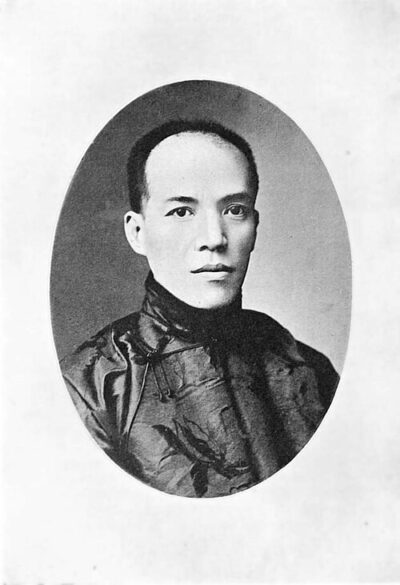
Liang Chi-chao
Liang Chi-chao was a Chinese politician, activist and journalist. Born February 23, 1873, in Huicheng Subdistrict. Died January 19, 1929, in Peking Union Medical College Hospital. Educated at National Tsing Hua University.
Facts
33 facts · 2 confirmed by two sources · 9 cited · 22 from one source
Where this comes from
Papalocal keeps its own record. It started from these sources; what each one said is kept here as it was copied, so a change on their side never changes this page by itself. Tap one to read its version.
What Wikidata says · copied November 16, 2026 · revision 2570024951
- Described as
- Chinese politician, activist and journalist (1873–1929)
- Other names
- she yuan mou, shuang tao, Leung Chi-tso, ai shi ke, Ch'i-ch'ao Liang, lin lu, man shu shi zhu ren, tan shan lv ke, yin bing, yin bing zi, ai guo zhe, cang jiang
- Born
- February 23, 1873 · 8 references
- Died
- January 19, 1929 · 7 references
- Born in
- Huicheng Subdistrict
- Died in
- Peking Union Medical College Hospital · 1 reference
- Buried in
- Tomb of Liang Qichao
- Citizen of
- Republic of China (1912–); Qing dynasty (–1912)
- Occupation
- translator; journalist · 1 reference; philosopher; historian · 1 reference; writer; politician · 2 references; revolutionary; educator
- Political party
- Democratic Party
- Worked for
- Tsinghua University
- Education
- National Tsing Hua University
- Field
- history; historian · 1 reference; pedagogy · 1 reference; political activity · 1 reference; journalism · 1 reference; creative and professional writing · 1 reference
- Children
- Liang Sicheng; Liang Siyong; Liang Sizhuang; Liang Sili; Liang Sida; Liang Lingxian · 1 reference; Liang Siyi
- Father
- Liang Baoying
- Religion
- Confucianism
- Wikipedias with a page
- 35
Wikidata item Q379836 (wikidata.org/wiki/Q379836), public domain (CC0). Copied November 16, 2026.
What Wikipedia says · copied November 16, 2026 · revision 1375604552
Liang Qichao (Chinese: 梁啓超; Wade–Giles: Liang2 Chʻi3-chʻao1; Jyutping: Loeng4 Kai2 Ciu1; February 23, 1873 – January 19, 1929) was a Chinese politician, social and political activist, journalist, and intellectual. His thought had a significant influence on the political reformation of modern China. He inspired Chinese scholars and activists with his writings and reform movements. His translations of Western and Japanese books into Chinese further introduced new theories and ideas and inspired young activists. Liang was of Taishanese descent.
In his youth, Liang joined his teacher Kang Youwei in the Hundred Days' Reform of 1898. When the movement was defeated, he fled to Japan and promoted a constitutional monarchy and organized political opposition to the dynasty. After the revolution of 1911, he joined the Beiyang government, serving as the chief justice and the first president of the currency system bureau. He became dissatisfied with Yuan Shikai and launched a movement to oppose his ambition to be emperor. After Yuan's death, he served as the finance chief of the Duan Qirui cabinet and as supervisor of the Salt Administration. He advocated the New Culture Movement and supported cultural change but not political revolution.
- Born, in its opening lines
- February 23, 1873
- Died, in its opening lines
- January 19, 1929
From the Wikipedia article “Liang Qichao” (en.wikipedia.org/wiki/Liang_Qichao), by its contributors, under CC BY-SA 4.0 (creativecommons.org/licenses/by-sa/4.0/). Copied November 16, 2026; not changed.
Confirmed Two sources agree. Cited One source, and it names where it got it. One source One source, without a reference of its own. Sources disagree The sources disagree. We show the best-supported value and keep theirs below.
