
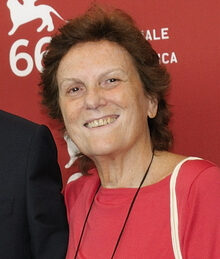
Liliana Cavani
Liliana Cavani is an Italian film director and screenwriter. Born January 12, 1933, in Carpi. Educated at University of Bologna and Experimental Centre of Cinematography. Awards include Commander of the Order of Merit of the Italian Republic and David di Donatello Award for Lifetime Achievement.
Facts
13 facts · 1 confirmed by two sources · 5 cited · 7 from one source
Where this comes from
Papalocal keeps its own record. It started from these sources; what each one said is kept here as it was copied, so a change on their side never changes this page by itself. Tap one to read its version.
What Wikidata says · copied November 16, 2026 · revision 2569084006
- Described as
- Italian film director and screenwriter
- Born
- January 12, 1933 · 5 references
- Born in
- Carpi
- Citizen of
- Italy
- Occupation
- film director · 2 references; screenwriter · 1 reference; director · 3 references
- Education
- University of Bologna; Experimental Centre of Cinematography · 1 reference
- Awards
- Commander of the Order of Merit of the Italian Republic · 2 references; David di Donatello Award for Lifetime Achievement
- Field
- film direction · 1 reference; film screenwriting · 1 reference
- Website
- http://www.lilianacavani.it
- Wikipedias with a page
- 44
Wikidata item Q55442 (wikidata.org/wiki/Q55442), public domain (CC0). Copied November 16, 2026.
What Wikipedia says · copied November 16, 2026 · revision 1381167158
Liliana Cavani (born 12 January 1933) is an Italian film director and screenwriter. Cavani became internationally known after the success of her 1974 feature film Il portiere di notte (The Night Porter). Her films have historical concerns. In addition to feature films and documentaries, she has also directed opera.
- Born, in its opening lines
- January 12, 1933
From the Wikipedia article “Liliana Cavani” (en.wikipedia.org/wiki/Liliana_Cavani), by its contributors, under CC BY-SA 4.0 (creativecommons.org/licenses/by-sa/4.0/). Copied November 16, 2026; not changed.
Confirmed Two sources agree. Cited One source, and it names where it got it. One source One source, without a reference of its own. Sources disagree The sources disagree. We show the best-supported value and keep theirs below.
