
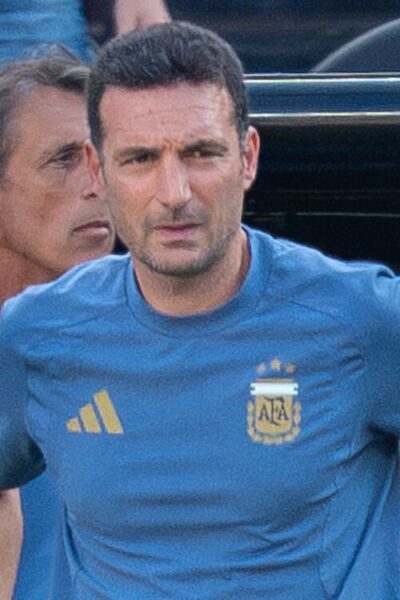
Lionel Scaloni
Lionel Scaloni is an Argentine football coach. Born May 16, 1978, in Pujato. Teams include SS Lazio (2007–2013), Newell's Old Boys (1994–1996) and West Ham United F.C. (2006).




Facts
19 facts · 1 confirmed by two sources · 14 cited · 4 from one source
Where this comes from
Papalocal keeps its own record. It started from these sources; what each one said is kept here as it was copied, so a change on their side never changes this page by itself. Tap one to read its version.
What Wikidata says · copied November 16, 2026 · revision 2550810726
- Described as
- Argentine football coach (born 1978)
- Other names
- Lionel Sebastián Scaloni, Lionel Sebastian Scaloni
- Born
- May 16, 1978 · 3 references
- Born in
- Pujato
- Name at birth
- Lionel Sebastián Scaloni · 1 reference
- Citizen of
- Argentina
- Occupation
- association football player (1994–2015) · 1 reference; association football coach (2016–) · 1 reference
- Teams
- SS Lazio (2007–2013) · 3 references; Newell's Old Boys (1994–1996) · 1 reference; West Ham United F.C. (2006) · 3 references; Racing de Santander (2006–2007) · 4 references; Deportivo de A Coruña (1997–2006) · 5 references; RCD Mallorca (2008–2009) · 4 references; Atalanta BC (2013–2015) · 3 references; Estudiantes de La Plata (1996–1997) · 1 reference; Argentina national under-20 football team (1997) · 1 reference; Argentina national football team (2003–2006) · 1 reference
- Sport
- association football
- Lived in
- Calvià · 1 reference
- Height
- 1.82 m (6 ft 0 in)
- Wikipedias with a page
- 56
Wikidata item Q311586 (wikidata.org/wiki/Q311586), public domain (CC0). Copied November 16, 2026.
What Wikipedia says · copied November 16, 2026 · revision 1385578086
Lionel Sebastián Scaloni (Rioplatense: [eskaˈloni], Italian: [skaˈloːni]; born 16 May 1978) is an Argentine professional football manager and former player who is the head coach of the Argentina national team. He is also an Italian citizen. Under his leadership, Argentina won the 2022 FIFA World Cup. Scaloni is regarded as one of the best national coaches in the world. A versatile player throughout his career as a footballer, he operated as a right-back or right midfielder.
Born in Pujato, Santa Fe Province, near Rosario, Scaloni debuted as a player for Newell's Old Boys in 1995. He spent most of his professional career in Spain, mainly at Deportivo de La Coruña, where he won the 1999–2000 Spanish league title and the 2001–02 Copa del Rey. In total, he amassed 258 games and 15 goals over 12 seasons in La Liga with three different teams. He also played for several years in Italy, with Lazio and Atalanta, before retiring in 2015. Internationally, he played for Argentina at under-20 level, and made his debut for the senior team in 2003; he won seven caps for the team between 2003 and 2006, and was part of their 2006 World Cup squad.
Scaloni began his coaching career in 2016, starting as an assistant at Sevilla and Argentina's under-20 team. In 2018, he was named the outright manager of the under-20 team, and was chosen to lead the Argentina senior team later that year. With the senior team, he guided them to third place at his first international tournament, the 2019 Copa América, in Brazil. He won the 2021 edition, Argentina's first such honour in 28 years, and then beat Italy in the 2022 Finalissima. Thereafter, the Scaloni-led national team won their third World Cup title, the first since 1986, in 2022 in Qatar. He also went on to win the 2024 Copa América as the Argentina manager, making him the first manager in football history to win three major international tournaments in a row. In 2026, he led Argentina to a second consecutive World Cup final, where they were defeated by Spain.
- Born, in its opening lines
- May 16, 1978
From the Wikipedia article “Lionel Scaloni” (en.wikipedia.org/wiki/Lionel_Scaloni), by its contributors, under CC BY-SA 4.0 (creativecommons.org/licenses/by-sa/4.0/). Copied November 16, 2026; not changed.
Confirmed Two sources agree. Cited One source, and it names where it got it. One source One source, without a reference of its own. Sources disagree The sources disagree. We show the best-supported value and keep theirs below.
