
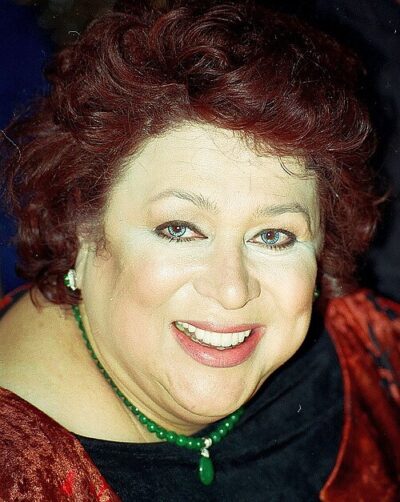
Liz Torres
Liz Torres is an American actress. Born September 27, 1947, in The Bronx. Educated at New York University.
Facts
14 facts · 1 confirmed by two sources · 3 cited · 10 from one source
Where this comes from
Papalocal keeps its own record. It started from these sources; what each one said is kept here as it was copied, so a change on their side never changes this page by itself. Tap one to read its version.
What Wikidata says · copied November 16, 2026 · revision 2562735892
- Described as
- American actress
- Other names
- Elizabeth Larrieu Torres
- Born
- September 27, 1947
- Born in
- The Bronx
- Name at birth
- Elizabeth Larrieu Torres
- Citizen of
- United States
- Occupation
- actor · 1 reference; singer; film actor; voice actor · 1 reference; television actor · 1 reference; comedian
- Education
- New York University
- Instrument
- voice
- Spouse
- Peter Locke
- Lived in
- Los Angeles
- Wikipedias with a page
- 21
Wikidata item Q443004 (wikidata.org/wiki/Q443004), public domain (CC0). Copied November 16, 2026.
What Wikipedia says · copied November 16, 2026 · revision 1373212411
Elizabeth Larrieu Torres (born September 27, 1947) is an American actress, singer, and comedian. Torres is best known for her role as Mahalia Sanchez in the NBC comedy series The John Larroquette Show (1993–1996), for which she received two Primetime Emmy and Golden Globe Award nominations. She is also known for her role as Patricia "Miss Patty" LaCosta in The WB family comedic drama series Amy Sherman-Palladino's Gilmore Girls (2000–07) starring Lauren Graham and Alexis Bledel. In the 1970s, she played Julie Erskine on Phyllis and also had a recurring role as Teresa Betancourt on All in the Family.
- Born, in its opening lines
- September 27, 1947
From the Wikipedia article “Liz Torres” (en.wikipedia.org/wiki/Liz_Torres), by its contributors, under CC BY-SA 4.0 (creativecommons.org/licenses/by-sa/4.0/). Copied November 16, 2026; not changed.
Confirmed Two sources agree. Cited One source, and it names where it got it. One source One source, without a reference of its own. Sources disagree The sources disagree. We show the best-supported value and keep theirs below.
