
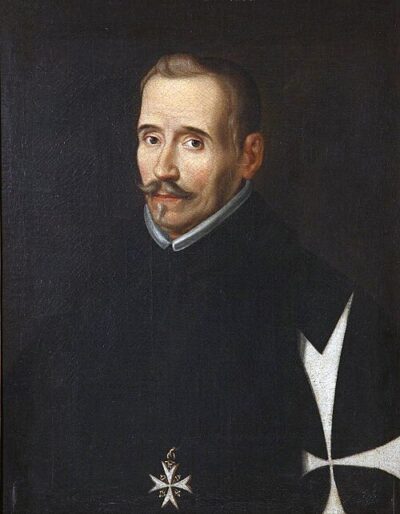
Lope de Vega
Lope de Vega was a Spanish playwright and poet. Born November 25, 1562, in Madrid. Died August 27, 1635, in Madrid. Known for Fuenteovejuna. Educated at University of Alcalá and Colegio Imperial de Madrid. Awards include Knight of the Sovereign Military Order of Malta.
Facts
25 facts · 2 confirmed by two sources · 9 cited · 14 from one source
Where this comes from
Papalocal keeps its own record. It started from these sources; what each one said is kept here as it was copied, so a change on their side never changes this page by itself. Tap one to read its version.
What Wikidata says · copied November 16, 2026 · revision 2564821783
- Described as
- Spanish playwright and poet (1562-1635)
- Other names
- Lopez de la Vega, Prodigy of Nature, Lope Félix de Vega Carpio, Phoenix of Wits, Félix Lope de Vega y Carpio, Félix Lope de 4545Vega Carpio
- Born
- November 25, 1562 · 6 references
- Died
- August 27, 1635 · 14 references
- Born in
- Madrid · 6 references
- Died in
- Madrid · 3 references
- Buried in
- San Sebastian Church · 1 reference
- Cause of death
- scarlet fever
- Name at birth
- Félix Lope de Vega Carpio
- Citizen of
- Spain · 1 reference
- Occupation
- playwright · 5 references; poet · 3 references; writer · 3 references; translator; Catholic priest (1614–); librettist · 1 reference
- Education
- University of Alcalá; Colegio Imperial de Madrid · 1 reference; Academia de Matemáticas, Madrid · 1 reference
- Member of
- Congregation of Secular Priests of Saint Peter the Apostle
- Genre
- theatre
- Known for
- Fuenteovejuna
- Awards
- Knight of the Sovereign Military Order of Malta (1627)
- Spouse
- Juana de Guardo (1598–1612); Isabel de Alderete y Urbina (1588–1594)
- Children
- Sor Marcela de San Felix
- Religion
- Catholicism
- Wikipedias with a page
- 125
Wikidata item Q165257 (wikidata.org/wiki/Q165257), public domain (CC0). Copied November 16, 2026.
What Wikipedia says · copied November 16, 2026 · revision 1383092200
Félix Lope de Vega y Carpio (; Spanish: [ˈlope ðe ˈβeɣa]; 25 November 1562 – 27 August 1635) was a Spanish playwright, poet, and novelist who was a key figure in the Spanish Golden Age (1492–1659) of Baroque literature. In the literature of Spain, Lope de Vega is often considered second only to Miguel de Cervantes. Cervantes said that Lope de Vega was “The Phoenix of Wits” (Fénix de los ingenios) and “Monster of Nature” (Monstruo de naturaleza).
Lope de Vega renewed the literary life of Spanish theatre when it became mass culture, and with the playwrights Pedro Calderón de la Barca and Tirso de Molina defined the characteristics of Spanish Baroque theatre with great insight into the human condition. The literary production of Lope de Vega includes 3,000 sonnets, three novels, four novellas, nine epic poems, and approximately 500 stageplays.
Personally and professionally, Lope de Vega was friend to the writer Francisco de Quevedo and arch-enemy of the dramatist Juan Ruiz de Alarcón. The volume of literary works produced by Lope de Vega earned him the envy of his contemporaries, such as Cervantes and Luis de Góngora, and the admiration of Johann Wolfgang von Goethe for such a vast and colourful oeuvre. Lope de Vega was also a close friend of Sebastian Francisco de Medrano, founder and president of the Medrano Academy (Poetic Academy of Madrid). He would attend Medrano's Academy from 1616 to 1622, and his relationship with Medrano is evident in his El Laurel de Apolo (1630) in silva VII.
- Born, in its opening lines
- November 25, 1562
- Died, in its opening lines
- August 27, 1635
From the Wikipedia article “Lope de Vega” (en.wikipedia.org/wiki/Lope_de_Vega), by its contributors, under CC BY-SA 4.0 (creativecommons.org/licenses/by-sa/4.0/). Copied November 16, 2026; not changed.
Confirmed Two sources agree. Cited One source, and it names where it got it. One source One source, without a reference of its own. Sources disagree The sources disagree. We show the best-supported value and keep theirs below.
