
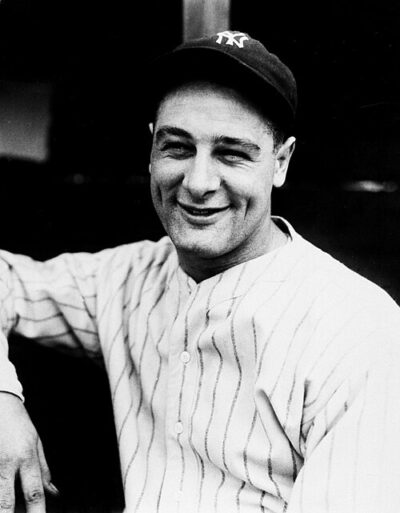
Lou Gehrig
Lou Gehrig was an American baseball player. Born June 19, 1903, in Manhattan. Died June 2, 1941, in Riverdale. Teams include New York Yankees, Columbia Lions football and Columbia Lions baseball. Educated at Columbia University. Awards include Major League Baseball Most Valuable Player Award.
Facts
17 facts · 2 confirmed by two sources · 6 cited · 9 from one source
Where this comes from
Papalocal keeps its own record. It started from these sources; what each one said is kept here as it was copied, so a change on their side never changes this page by itself. Tap one to read its version.
What Wikidata says · copied November 15, 2026 · revision 2567540838
- Described as
- American baseball player (1903–1941)
- Other names
- Henry Louis "Lou" Gehrig, Henry Louis Gehrig, Iron Horse
- Born
- June 19, 1903 · 6 references
- Died
- June 2, 1941 · 6 references
- Born in
- Manhattan
- Died in
- Riverdale
- Buried in
- Kensico Cemetery · 1 reference
- Cause of death
- amyotrophic lateral sclerosis · 2 references
- Citizen of
- United States
- Occupation
- baseball player · 1 reference
- Education
- Columbia University
- Teams
- New York Yankees; Columbia Lions football · 1 reference; Columbia Lions baseball · 1 reference
- Sport
- baseball · 1 reference
- Awards
- Major League Baseball Most Valuable Player Award (1935) · 1 reference
- Field
- sport · 1 reference
- Spouse
- Eleanor Gehrig
- Website
- http://www.lougehrig.com/
- Wikipedias with a page
- 39
Wikidata item Q357444 (wikidata.org/wiki/Q357444), public domain (CC0). Copied November 15, 2026.
What Wikipedia says · copied November 15, 2026 · revision 1383790417
Henry Louis Gehrig ( GAIR-ig; born Heinrich Ludwig Gehrig; June 19, 1903 – June 2, 1941) was an American professional baseball first baseman who played 17 seasons in Major League Baseball (MLB) for the New York Yankees. Gehrig was renowned for his prowess as a hitter and for his durability, which earned him the nickname "the Iron Horse", and he is regarded as one of the greatest baseball players of all time. Gehrig was an All-Star seven consecutive times, a Triple Crown winner once, an American League (AL) Most Valuable Player twice and a member of six World Series champion teams. He had a career .340 batting average, .632 slugging average, and a .447 on-base average. He hit 493 home runs and had 1,995 runs batted in (RBIs). He is also one of 21 players to hit four home runs in a single game. In 1939, Gehrig was elected to the Baseball Hall of Fame and was the first MLB player to have his uniform number retired by a team when his number 4 was retired by the Yankees.
A native of New York City and a student at Columbia University, Gehrig signed with the Yankees on April 29, 1923. He set several major-league records during his career, including the most career grand slams (23; since broken by Alex Rodriguez) and most consecutive games played (2,130), a record that stood for 56 years and was considered unbreakable until Cal Ripken Jr. surpassed it in 1995. Gehrig's consecutive game streak ended on May 2, 1939, when he voluntarily took himself out of the lineup, stunning both players and fans, after his performance in the field had become hampered by an undiagnosed ailment; it was subsequently confirmed to be amyotrophic lateral sclerosis (ALS), an incurable neuromuscular illness that since then is sometimes referred to as "Lou Gehrig's disease" in the United States.
Gehrig never played again and retired in 1939 at age 36. Two weeks later, the ball club held a Lou Gehrig Appreciation Day on July 4, 1939, at the close of which he delivered his speech declaring himself the "luckiest man on the face of the earth" at Yankee Stadium. Two years later, Gehrig died of complications from ALS. In 1969, the Baseball Writers' Association of America voted Gehrig the greatest first baseman of all time, and he was the leading vote-getter on the MLB All-Century Team, chosen by fans in 1999. A monument in Gehrig's honor, originally dedicated by the Yankees in 1941, prominently features in Monument Park at the new Yankee Stadium. The Lou Gehrig Memorial Award is given annually to the MLB player who best exhibits Gehrig's integrity and character.
- Born, in its opening lines
- June 19, 1903
- Died, in its opening lines
- June 2, 1941
From the Wikipedia article “Lou Gehrig” (en.wikipedia.org/wiki/Lou_Gehrig), by its contributors, under CC BY-SA 4.0 (creativecommons.org/licenses/by-sa/4.0/). Copied November 15, 2026; not changed.
Confirmed Two sources agree. Cited One source, and it names where it got it. One source One source, without a reference of its own. Sources disagree The sources disagree. We show the best-supported value and keep theirs below.
