
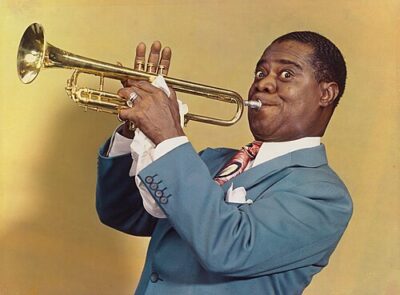
Louis Armstrong
Louis Armstrong was an American jazz musician, trumpeter and singer. Born August 4, 1901, in New Orleans. Died July 6, 1971, in Corona. Known for Louis Armstrong--a self-portrait. Awards include Grammy Lifetime Achievement Award, star on Hollywood Walk of Fame and Rock and Roll Hall of Fame.
Facts
39 facts · 2 confirmed by two sources · 11 cited · 26 from one source
Where this comes from
Papalocal keeps its own record. It started from these sources; what each one said is kept here as it was copied, so a change on their side never changes this page by itself. Tap one to read its version.
What Wikidata says · copied November 13, 2026 · revision 2559678055
- Described as
- American jazz musician, trumpeter and singer (1901–1971)
- Other names
- Satchmo, Satchelmouth, Pops, Dipper, Satch, Louis Daniel Armstrong
- Born
- August 4, 1901 · 5 references
- Died
- July 6, 1971 · 5 references
- Born in
- New Orleans · 3 references
- Died in
- Corona · 2 references
- Buried in
- Flushing Cemetery · 1 reference
- Cause of death
- myocardial infarction · 1 reference
- Name at birth
- Louis Daniel Armstrong · 1 reference
- Citizen of
- United States · 1 reference
- Occupation
- actor · 1 reference; street artist; trumpeter · 1 reference; bandleader · 1 reference; conductor · 1 reference; jazz musician · 1 reference; singer · 1 reference; film score composer · 1 reference
- Member of
- Louis Armstrong & His Orchestra · 1 reference; Louis Armstrong and His Hot Five; Louis Armstrong and His All-Stars; Ella Fitzgerald & Louis Armstrong
- Genre
- jazz
- Instrument
- trumpet; cornet; voice
- Record label
- ABC Records · 1 reference; Audio Fidelity · 1 reference; Columbia Records · 1 reference; Decca · 1 reference
- Known for
- Louis Armstrong--a self-portrait
- Awards
- Grammy Lifetime Achievement Award (1972); star on Hollywood Walk of Fame (1960) · 1 reference; Rock and Roll Hall of Fame (1990) · 1 reference
- Spouse
- Lucille Armstrong (1942–1971) · 1 reference; Lil Hardin Armstrong (1924–1938)
- Nickname
- Satchmo · 1 reference; Satch · 1 reference; Pops · 1 reference; Dipper · 1 reference
- Website
- https://louisarmstronghouse.org
- Wikipedias with a page
- 179
Wikidata item Q1779 (wikidata.org/wiki/Q1779), public domain (CC0). Copied November 13, 2026.
What Wikipedia says · copied November 13, 2026 · revision 1384444787
Louis Daniel Armstrong (August 4, 1901 – July 6, 1971), nicknamed "Satchmo", "Satch", and "Pops", was an American jazz and blues trumpeter and vocalist. Among the most influential figures in jazz, his career spanned five decades and several eras in the history of the genre. Armstrong received numerous accolades, including the Grammy Award for Best Male Vocal Performance for "Hello, Dolly!" in 1965, as well as a posthumous win for the Grammy Lifetime Achievement Award in 1972. His influence crossed musical genres, with inductions into the DownBeat Jazz Hall of Fame, the Rock and Roll Hall of Fame, and the National Rhythm & Blues Hall of Fame, among others.
Armstrong was born and raised in New Orleans. Coming to prominence in the 1920s as an inventive trumpet and cornet player, he was a foundational influence in jazz, shifting the focus of the music from collective improvisation to solo performance. Around 1922, Armstrong followed his mentor, Joe "King" Oliver, to Chicago to play in Oliver's Creole Jazz Band. Armstrong earned a reputation at "cutting contests", and his fame reached bandleader Fletcher Henderson. Armstrong moved to New York City, where he became a featured and musically influential band soloist and recording artist. By the 1950s, he was an international musical icon, appearing regularly in radio and television broadcasts and on film. Apart from his music, he was also beloved as an entertainer, often joking with the audience and keeping a joyful public image at all times.
Armstrong's best known songs include "What a Wonderful World", "La Vie en rose", "Hello, Dolly!", "On the Sunny Side of the Street", "Dream a Little Dream of Me", "When You're Smiling", and "When the Saints Go Marching In". He collaborated with Ella Fitzgerald, producing three records together: Ella and Louis (1956), Ella and Louis Again (1957), and Porgy and Bess (1959). He also appeared in films such as A Rhapsody in Black and Blue (1932), Cabin in the Sky (1943), High Society (1956), Paris Blues (1961), A Man Called Adam (1966), and Hello, Dolly! (1969).
With his instantly recognizable, rich, gravelly voice, Armstrong was also an influential singer and skillful improviser. He was also skilled at scat singing. By the end of Armstrong's life, his influence had spread to popular music. He was one of the first popular African-American entertainers to "cross over" to wide popularity with white and international audiences. He rarely publicly discussed racial issues, sometimes to the dismay of fellow black Americans, but took a well-publicized stand for desegregation in the Little Rock Crisis. He could access the upper echelons of American society at a time when this was difficult for black men. His recording of "Melancholy Blues" is included on the Voyager Golden Record, a sample of the sights and sounds of Earth sent into space.
- Born, in its opening lines
- August 4, 1901
- Died, in its opening lines
- July 6, 1971
From the Wikipedia article “Louis Armstrong” (en.wikipedia.org/wiki/Louis_Armstrong), by its contributors, under CC BY-SA 4.0 (creativecommons.org/licenses/by-sa/4.0/). Copied November 13, 2026; not changed.
Confirmed Two sources agree. Cited One source, and it names where it got it. One source One source, without a reference of its own. Sources disagree The sources disagree. We show the best-supported value and keep theirs below.
