
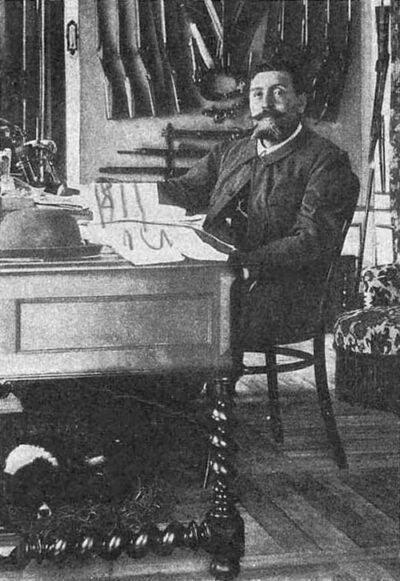
Louis Henri Boussenard
Louis Henri Boussenard was a French author. Born October 4, 1847, in Escrennes. Died September 11, 1910, in Orléans. Educated at Paris Medical Faculty.
Facts
19 facts · 2 confirmed by two sources · 4 cited · 13 from one source
What’s different
- Born: we show October 4, 1847 (Confirmed). Wikidata also lists October 1, 1847
- Died: we show September 11, 1910 (Confirmed). Wikidata also lists November 11, 1910 and September 9, 1910
Where this comes from
Papalocal keeps its own record. It started from these sources; what each one said is kept here as it was copied, so a change on their side never changes this page by itself. Tap one to read its version.
What Wikidata says · copied November 18, 2026 · revision 2567936206
- Described as
- French author (1847–1910)
- Born
- October 4, 1847 · 5 references; October 1, 1847 · 1 reference
- Died
- September 11, 1910 · 4 references; November 11, 1910 · 1 reference; September 9, 1910 · 1 reference
- Born in
- Escrennes
- Died in
- Orléans · 1 reference
- Buried in
- Escrennes
- Citizen of
- France
- Occupation
- explorer; writer · 2 references; physician · 1 reference; science fiction writer; novelist; journalist · 1 reference
- Worked for
- Journal des Voyages (1879–)
- Education
- Paris Medical Faculty
- Lived in
- Escrennes; Pithiviers; Paris; French Guiana; Nanteau-sur-Essonne
- Wikipedias with a page
- 20
Wikidata item Q1518051 (wikidata.org/wiki/Q1518051), public domain (CC0). Copied November 18, 2026.
What Wikipedia says · copied November 18, 2026 · revision 1370608554
Louis Henri Boussenard (4 October 1847, Escrennes, Loiret – 11 September 1910 in Orléans) was a French author of adventure novels, dubbed "the French Rider Haggard" during his lifetime, but known better presently in Eastern Europe than in Francophone countries. As a measure of his popularity, 40 volumes of his collected works were published in Imperial Russia during 1911.
A physician by profession, Boussenard travelled throughout the French colonies, especially in Africa. He was drafted during the Franco-Prussian War but soon capitulated to the Prussian soldiers, an experience that could explain a nationalist theme present in many of his novels. Some of his books demonstrate a certain disdain of Britons and Americans, a fact which likely contributed to his obscurity and lack of translations in the English-speaking countries.
The author's picaresque humour flourished in his earliest books, À travers Australie: Les dix millions de l'Opossum rouge (1879), Le tour du monde d'un gamin de Paris (1880), Les Robinsons de la Guyane (1882), Aventures périlleuses de trois Français au pays des diamants (1884, set in a mysterious cavern underneath the Victoria Falls), The Crusoes of Guyana; or, The White Tiger (1885), and Les étrangleurs du Bengale (1901).
Boussenard's best-known book Le Capitaine Casse-Cou (1901) was set at the time of the Second Boer War. L'île en feu (1898) fictionalized Cuba's struggle for independence. Aspiring to emulate Jules Verne, Boussenard also produced several science fiction novels, notably Les secrets de monsieur Synthèse (1888) and Dix mille ans dans un bloc de glace (1890), both translated by Brian Stableford in 2013 with the title Monsieur Synthesis ISBN 978-1-61227-161-3
- Born, in its opening lines
- October 4, 1847
- Died, in its opening lines
- September 11, 1910
From the Wikipedia article “Louis Henri Boussenard” (en.wikipedia.org/wiki/Louis_Henri_Boussenard), by its contributors, under CC BY-SA 4.0 (creativecommons.org/licenses/by-sa/4.0/). Copied November 18, 2026; not changed.
Confirmed Two sources agree. Cited One source, and it names where it got it. One source One source, without a reference of its own. Sources disagree The sources disagree. We show the best-supported value and keep theirs below.
