
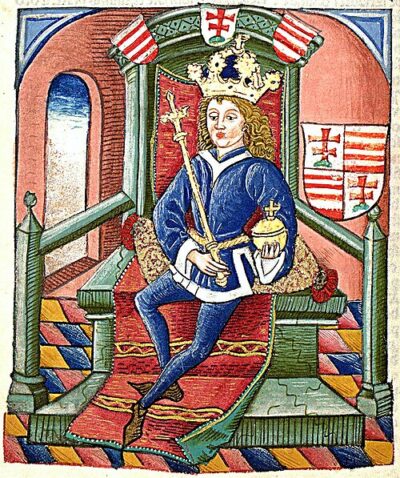
Louis I of Hungary
Louis I of Hungary was a King of Hungary, Poland and Croatia. Born March 5, 1326, in Visegrád. Died September 10, 1382, in Trnava. Positions held include King of Poland (1370–1382). Awards include Golden Rose.
Facts
21 facts · 2 confirmed by two sources · 2 cited · 17 from one source
Where this comes from
Papalocal keeps its own record. It started from these sources; what each one said is kept here as it was copied, so a change on their side never changes this page by itself. Tap one to read its version.
What Wikidata says · copied November 16, 2026 · revision 2569841181
- Described as
- King of Hungary, Poland and Croatia
- Other names
- Anjou I Lajos, Ludwik Węgierski, Louis the Great
- Born
- March 5, 1326 · 1 reference
- Died
- September 10, 1382 · 1 reference
- Born in
- Visegrád · 1 reference
- Died in
- Trnava · 1 reference
- Buried in
- Székesfehérvár Basilica
- Citizen of
- Hungary
- Occupation
- monarch
- Positions held
- King of Poland (1370–1382)
- Awards
- Golden Rose
- Spouse
- Margaret of Bohemia, Queen of Hungary (1338–) · 1 reference; Elizabeth of Bosnia (1353–) · 1 reference
- Children
- Catherine of Hungary; Mary I of Hungary · 1 reference; Jadwiga I of Poland · 1 reference
- Father
- Charles I of Hungary
- Mother
- Elizabeth of Poland, Queen of Hungary
- Siblings
- Andrew, Duke of Calabria; Stephen, Duke of Slavonia; Coloman of Hungary; Catherine of Hungary, Duchess of Świdnica
- Religion
- Christianity
- Wikipedias with a page
- 58
Wikidata item Q53998 (wikidata.org/wiki/Q53998), public domain (CC0). Copied November 16, 2026.
What Wikipedia says · copied November 16, 2026 · revision 1375429328
Louis I of Hungary, also known as Louis the Great (Hungarian: Nagy Lajos; Croatian: Ludovik Veliki; Slovak: Ľudovít Veľký) or Louis the Hungarian (Polish: Ludwik Węgierski, Italian: Luigi l'ungherese; 5 March 1326 – 10 September 1382), was King of Hungary and Croatia from 1342 and King of Poland from 1370 until his death in 1382. He was the first child of Charles I of Hungary and his wife, Elizabeth of Poland, to survive infancy. A 1338 treaty between his father and Casimir III of Poland, Louis's maternal uncle, confirmed Louis's right to inherit the Kingdom of Poland if his uncle died without a son. In exchange, Louis was obliged to assist his uncle in reoccupying the lands that Poland had lost in previous decades. He bore the title Duke of Transylvania between 1339 and 1342 but did not administer the province.
Louis was of age when he succeeded his father in 1342, but his deeply religious mother exerted a powerful influence on him. He inherited a centralised kingdom and a rich treasury from his father. During the first years of his reign, Louis launched a crusade against the Lithuanians and restored royal power in Croatia; his troops defeated a Tatar army, expanding his authority towards the Black Sea. When his brother, Andrew, Duke of Calabria, husband of Queen Joanna I of Naples, was assassinated in 1345, Louis accused the queen of his murder and punishing her became the principal goal of his foreign policy. He launched two campaigns to the Kingdom of Naples between 1347 and 1350. His troops occupied large territories on both occasions, and Louis adopted the styles of Neapolitan sovereigns (including the title of King of Sicily and Jerusalem), but the Holy See never recognised his claim. Louis's arbitrary acts and atrocities committed by his mercenaries made his rule unpopular in Southern Italy. He withdrew all his troops from the Kingdom of Naples in 1351.
Like his father, Louis administered Hungary with absolute power and used royal prerogatives to grant privileges to his courtiers. However, he also confirmed the liberties of the Hungarian nobility at the Diet of 1351, emphasising the equal status of all noblemen. At the same Diet, he introduced an entail system and a uniform rent payable by the peasants to the landowners, and confirmed the right to free movement for all peasants. He waged wars against the Lithuanians, Serbia, and the Golden Horde in the 1350s, restoring the authority of Hungarian monarchs over territories along frontiers that had been lost during previous decades. He forced the Republic of Venice to renounce the Dalmatian towns in 1358. He also made several attempts to expand his suzerainty over the rulers of Bosnia, Moldavia, Wallachia, and parts of Bulgaria and Serbia. These rulers were sometimes willing to yield to him, either under duress or in the hope of support against their internal opponents, but Louis's rule in these regions was only nominal during most of his reign. His attempts to convert his pagan or Orthodox subjects to Catholicism made him unpopular in the Balkan states. Louis established a university in Pécs in 1367, but it was closed within two decades because he did not arrange for sufficient revenues to maintain it.
Louis inherited Poland after his uncle's death in 1370. Since he had no sons, he wanted his subjects to acknowledge the right of his daughters to succeed him in both Hungary and Poland. For this purpose, he issued the Privilege of Koszyce (now Košice in Slovakia) in 1374, spelling out the liberties of Polish noblemen. However, his rule remained unpopular in Poland. In Hungary, he authorised the royal free cities to delegate jurors to the high court, hearing their cases and set up a new high court. Suffering from a skin disease, Louis became even more religious during the last years of his life. At the beginning of the Western Schism, he acknowledged Urban VI as the legitimate pope. After Urban deposed Joanna and put Louis's relative Charles of Durazzo on the throne of Naples, Louis helped Charles occupy the kingdom. In Hungarian historiography, Louis was regarded for centuries as the most powerful Hungarian monarch who ruled over an empire "whose shores were washed by three seas".
- Born, in its opening lines
- March 5, 1326
- Died, in its opening lines
- September 10, 1382
From the Wikipedia article “Louis I of Hungary” (en.wikipedia.org/wiki/Louis_I_of_Hungary), by its contributors, under CC BY-SA 4.0 (creativecommons.org/licenses/by-sa/4.0/). Copied November 16, 2026; not changed.
Confirmed Two sources agree. Cited One source, and it names where it got it. One source One source, without a reference of its own. Sources disagree The sources disagree. We show the best-supported value and keep theirs below.
