
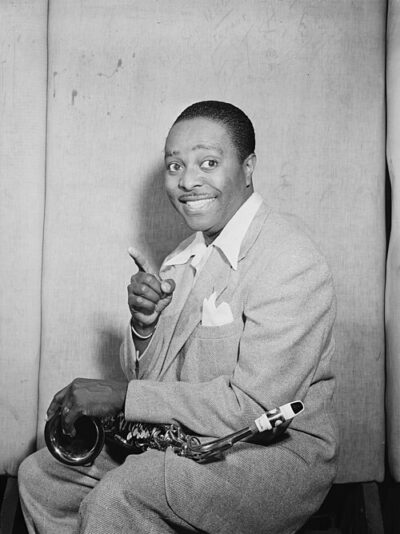
Louis Jordan
Louis Jordan was an American jazz, blues and rhythm and blues musician, songwriter and bandleader. Born July 8, 1908, in Brinkley. Died February 4, 1975, in Los Angeles. Educated at Arkansas Baptist College. Awards include Grammy Lifetime Achievement Award, Rock and Roll Hall of Fame and Arkansas Entertainers Hall of Fame.
Facts
34 facts · 2 confirmed by two sources · 15 cited · 17 from one source
Where this comes from
Papalocal keeps its own record. It started from these sources; what each one said is kept here as it was copied, so a change on their side never changes this page by itself. Tap one to read its version.
What Wikidata says · copied November 15, 2026 · revision 2563861092
- Described as
- American jazz, blues and rhythm and blues musician, songwriter and bandleader (1908–1975)
- Other names
- Louis Thomas Jordan
- Born
- July 8, 1908 · 7 references
- Died
- February 4, 1975 · 8 references
- Born in
- Brinkley · 3 references
- Died in
- Los Angeles · 2 references
- Cause of death
- myocardial infarction
- Citizen of
- United States
- Occupation
- singer; actor; saxophonist; jazz musician; musician · 2 references; composer · 2 references; bandleader · 1 reference
- Education
- Arkansas Baptist College
- Member of
- Louis Jordan and his Tympany Five
- Genre
- jazz; blues
- Instrument
- saxophone; voice; clarinet
- Record label
- Decca; Mercury Records; Aladdin Records
- Awards
- Grammy Lifetime Achievement Award (2018) · 1 reference; Rock and Roll Hall of Fame (1987) · 1 reference; Arkansas Entertainers Hall of Fame (1998) · 1 reference; Arkansas Black Hall of Fame (2005) · 1 reference
- Field
- music · 1 reference; pop music · 1 reference; jazz · 1 reference; saxophone performance · 1 reference; singing · 1 reference; popular music · 1 reference
- Website
- https://www.rockhall.com/inductees/louis-jordan
- Wikipedias with a page
- 29
Wikidata item Q461011 (wikidata.org/wiki/Q461011), public domain (CC0). Copied November 15, 2026.
What Wikipedia says · copied November 15, 2026 · revision 1382029903
Louis Thomas Jordan (July 8, 1908 – February 4, 1975) was an American jazz, blues and jump blues saxophonist, vocalist, songwriter and bandleader who was popular from the late 1930s to the early 1950s. Known as "the King of the Jukebox", he earned his highest profile towards the end of the swing era.
Specializing in the alto sax, Jordan played all forms of the saxophone, as well as piano and clarinet. He also was a singer with great comedic flair, and fronted his own band for more than twenty years. He duetted with some of the biggest solo singing stars of his time, including Bing Crosby, Ella Fitzgerald, and Louis Armstrong.
Jordan began his career in big-band swing jazz in the 1930s, coming to the public's attention as part of Chick Webb's hard swinging band, though he became better known as an innovative popularizer of jump blues—a swinging, up-tempo, dance-oriented hybrid of jazz, blues and boogie-woogie. Typically performed by smaller bands consisting of five or six players, jump music featured shouted, highly syncopated vocals and earthy, comedic lyrics on contemporary urban themes. It strongly emphasized the rhythm section of piano, bass and drums; after the mid-1940s, this mix was often augmented by electric guitar. Jordan's band also pioneered the use of the electronic organ.
With his dynamic bands that he called The Tympany Five no matter how many musicians were in it, Jordan mapped out the main parameters of the classic R&B, urban blues and early rock-and-roll genres with a series of highly influential 78-rpm discs released by Decca Records. These recordings presaged many of the styles of black popular music of the late 1940s, 1950s and 1960s and exerted a strong influence on many leading performers in these genres. Many of his records were produced by Milt Gabler who, in his later production work, played Jordan's music for Bill Haley as Haley wanted to transition from country & western to rock 'n' roll resulting in Haley's huge hit, "Rock Around the Clock".
Jordan was also an actor and a film personality. He appeared in 14 three-minute Soundies filmed for "movie jukeboxes" of the 1940s. He also worked as a specialty act in the Hollywood theatrical features Follow the Boys and Swing Parade of 1946. His very successful musical short Caldonia (1945) prompted three more feature films, all starring Jordan and his band: Beware; Reet, Petite and Gone; and Look-Out Sister.
Jordan ranks fifth in the list of the most successful African-American recording artists according to Joel Whitburn's analysis of Billboard magazine's R&B chart, and was the most popular rhythm and blues artist with his jump blues recordings of the pre-rock n' roll era. Though comprehensive sales figures are not available, Jordan had at least four million-selling hits during his career and regularly topped the R&B "race" charts, reaching Number 1 a total of 18 times, with 113 weeks in that spot over the years. He was also one of the first black recording artists to achieve significant crossover in popularity with the predominantly white mainstream American audience, having simultaneous top ten hits on the pop charts several times.
- Born, in its opening lines
- July 8, 1908
- Died, in its opening lines
- February 4, 1975
From the Wikipedia article “Louis Jordan” (en.wikipedia.org/wiki/Louis_Jordan), by its contributors, under CC BY-SA 4.0 (creativecommons.org/licenses/by-sa/4.0/). Copied November 15, 2026; not changed.
Confirmed Two sources agree. Cited One source, and it names where it got it. One source One source, without a reference of its own. Sources disagree The sources disagree. We show the best-supported value and keep theirs below.
