
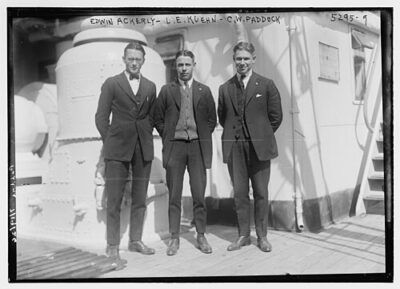
Louis Kuehn was a diver. Born April 2, 1901, in Portland. Died March 30, 1981, in West Linn. Educated at Oregon State University.
Facts
9 facts · 2 confirmed by two sources · 1 cited · 6 from one source
Where this comes from
Papalocal keeps its own record. It started from these sources; what each one said is kept here as it was copied, so a change on their side never changes this page by itself. Tap one to read its version.
What Wikidata says · copied November 18, 2026 · revision 2554558331
- Described as
- diver (1901–1981)
- Born
- April 2, 1901
- Died
- March 30, 1981
- Born in
- Portland
- Died in
- West Linn
- Citizen of
- United States
- Occupation
- competitive diver
- Education
- Oregon State University
- Sport
- diving (sport)
- Nickname
- Hap · 1 reference
- Wikipedias with a page
- 18
Wikidata item Q2247039 (wikidata.org/wiki/Q2247039), public domain (CC0). Copied November 18, 2026.
What Wikipedia says · copied November 18, 2026 · revision 1368942593
Louis Edward "Hap" Kuehn (April 2, 1901 – March 30, 1981) was an American diver who competed for Oklahoma State University and participated in the 1920 Summer Olympics where he won a gold medal in springboard diving.
Lois Edward Kuehn was born April 2, 1901 in greater Portland, Oregon to German immigrant Louis Kuehn and Dorothea Schaeffer Kuehn. By 18, he competed in swimming and diving with the strong program at the Portland's Multinomah Club where he was coached by Jack Cody, an International Swimming Hall of Fame inductee.
Kuehn was twice a state diving champion before capturing the national Junior championship in 1919 prior to attending the Olympics. Kuehn finished second at the 1920 AAU Diving Championships.
- Born, in its opening lines
- April 2, 1901
- Died, in its opening lines
- March 30, 1981
From the Wikipedia article “Louis Kuehn” (en.wikipedia.org/wiki/Louis_Kuehn), by its contributors, under CC BY-SA 4.0 (creativecommons.org/licenses/by-sa/4.0/). Copied November 18, 2026; not changed.
Confirmed Two sources agree. Cited One source, and it names where it got it. One source One source, without a reference of its own. Sources disagree The sources disagree. We show the best-supported value and keep theirs below.
