
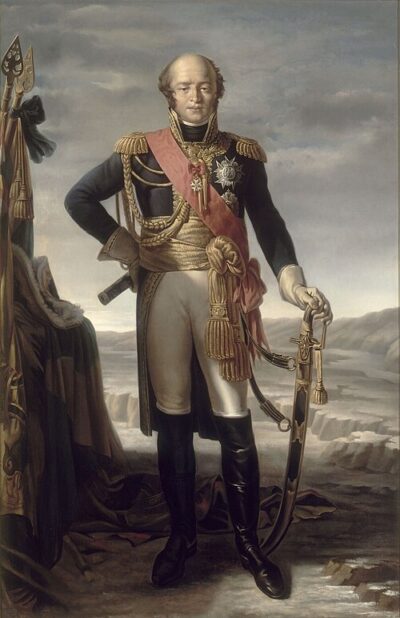
Louis-Nicolas Davout
Louis-Nicolas Davout was a Marshal of France. Born May 10, 1770, in Annoux. Died June 1, 1823, in Paris. Positions held include Mayor of Savigny-sur-Orge, Minister of War and Peer of France. Awards include Grand Cross of the Legion of Honour, Marshal of the Empire and Knight of the Royal and Military Order of Saint Louis.
Facts
39 facts · 2 confirmed by two sources · 9 cited · 28 from one source
Where this comes from
Papalocal keeps its own record. It started from these sources; what each one said is kept here as it was copied, so a change on their side never changes this page by itself. Tap one to read its version.
What Wikidata says · copied November 16, 2026 · revision 2565504361
- Described as
- Marshal of France (1770–1823)
- Other names
- Prince d'Eckmühl
- Born
- May 10, 1770 · 11 references
- Died
- June 1, 1823 · 11 references
- Born in
- Annoux · 1 reference
- Died in
- Paris · 2 references
- Buried in
- Grave of Louis Nicolas Davout
- Cause of death
- tuberculosis
- Citizen of
- France
- Occupation
- politician; military officer · 1 reference; military leader · 1 reference; marshal · 2 references
- Positions held
- Mayor of Savigny-sur-Orge; Minister of War; Peer of France
- Awards
- Grand Cross of the Legion of Honour; Marshal of the Empire (1804–); Knight of the Royal and Military Order of Saint Louis; Marshal of France; Grand Cross of the Military Order of Maria Theresa; list of names inscribed on the Arc de Triomphe; Godfather promotion of Special Military School of Saint-Cyr; Grand Cross of the Order of Military Virtue · 1 reference; Order of the Iron Crown (Austria) · 1 reference; Order of Saint Stephen of Hungary · 1 reference; Military Order of Maria Theresa · 1 reference; Knight Grand Cordon of the Order of Christ (1810) · 1 reference
- Field
- military affairs · 1 reference
- Spouse
- Aimée Davout (1801–) · 1 reference; Adelaide Séguenot (1791–1794) · 1 reference
- Children
- Adélaïde-Louise d'Eckmühl de Blocqueville; Joséphine Davout d'Auerstaedt; Napoléon-Louis Davout; Adèle Napoléonie Davout d'Eckmühl
- Father
- Jean-François d'Avout
- Mother
- Françoise-Adélaïde Minard de Velars
- Siblings
- Louis Alexandre Davout
- Military branch
- French Army
- Military rank
- Marshal of the Empire; general · 2 references
- Wikipedias with a page
- 50
Wikidata item Q158778 (wikidata.org/wiki/Q158778), public domain (CC0). Copied November 16, 2026.
What Wikipedia says · copied November 16, 2026 · revision 1379594833
Louis-Nicolas d'Avout (English: duh-VOO, French: [lwi nikɔla davu]; 10 May 1770 – 1 June 1823), better known as Davout, 1st Prince of Eckmühl, 1st Duke of Auerstaedt, was a French military commander and Marshal of the Empire who served during both the French Revolutionary Wars and the Napoleonic Wars. His talent for war, along with his reputation as a stern disciplinarian, earned him the nickname "The Iron Marshal" (Le Maréchal de fer). He is ranked as one of Napoleon's finest commanders, and also stands among the most outstanding military commanders of the modern era.
Born into a minor noble family in Burgundy, Davout was educated at the École Militaire and joined a royal cavalry regiment in 1788. On the outbreak of the French Revolution, Davout embraced the revolutionary cause and first distinguished himself at the Battle of Neerwinden. Rapidly rising through the ranks, he took part in the 1796 Rhine campaign and Napoleon's Egyptian expedition, and by 1800 he had reached the rank of divisional general.
Davout was named one of the original 18 Marshals of the Empire upon Napoleon's ascension as Emperor in 1804. As commander of the III Corps of the Grande Armée, he played a major role in the French victory at Austerlitz. He achieved further successes at Auerstedt—where he routed the Prussian army of the Duke of Brunswick despite being vastly outnumbered—as well as Eylau, Eckmühl and Wagram. In 1807, Napoleon named him governor-general of the Duchy of Warsaw and granted him the title Duke of Auerstaedt. Davout took part in Napoleon's disastrous invasion of Russia, and was in the middle of a six-month siege of Hamburg when Napoleon abdicated.
Davout went into retirement upon the First Restoration of the Bourbons. He rejoined Napoleon during the Hundred Days and was appointed Minister of War, but did not receive a field command. Following Napoleon's final defeat at Waterloo, he held Paris until July when he ultimately submitted to the again restored Bourbon monarchy, after which he was exiled and deprived of his titles. In 1819, his titles were restored and he was made a Peer of France.
- Born, in its opening lines
- May 10, 1770
- Died, in its opening lines
- June 1, 1823
From the Wikipedia article “Louis-Nicolas Davout” (en.wikipedia.org/wiki/Louis-Nicolas_Davout), by its contributors, under CC BY-SA 4.0 (creativecommons.org/licenses/by-sa/4.0/). Copied November 16, 2026; not changed.
Confirmed Two sources agree. Cited One source, and it names where it got it. One source One source, without a reference of its own. Sources disagree The sources disagree. We show the best-supported value and keep theirs below.
