
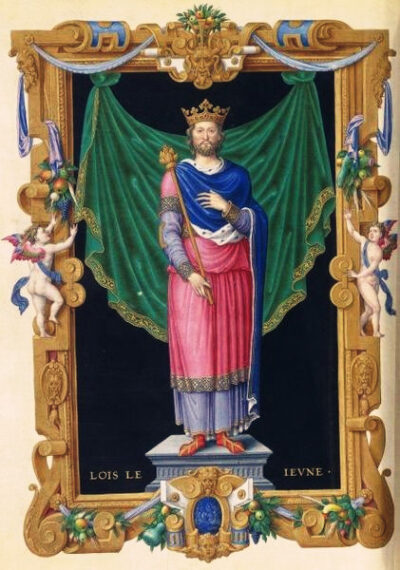
Louis VII of France
Louis VII of France was a King of France from 1137 to 1180. Born 1120, in Paris. Died September 18, 1180, in Paris. Positions held include king of Franks (1137–1180) and duke of Aquitaine. Awards include Golden Rose.
Facts
29 facts · 2 confirmed by two sources · 7 cited · 20 from one source
Where this comes from
Papalocal keeps its own record. It started from these sources; what each one said is kept here as it was copied, so a change on their side never changes this page by itself. Tap one to read its version.
What Wikidata says · copied November 16, 2026 · revision 2569065246
- Described as
- King of France from 1137 to 1180 (1120–1180)
- Other names
- Lois VII, the Young, Louis VII
- Born
- 1120
- Died
- September 18, 1180 · 4 references
- Born in
- Paris
- Died in
- Paris · 1 reference
- Buried in
- Basilica of Saint-Denis
- Citizen of
- France
- Occupation
- sovereign; monarch
- Positions held
- king of Franks (1137–1180); duke of Aquitaine
- Awards
- Golden Rose
- Spouse
- Eleanor of Aquitaine (1137–) · 2 references; Constance of León (1154–) · 2 references; Adèle of Champagne (1160–) · 2 references
- Children
- Margaret of France; Marie of France, Countess of Champagne; Alice of France; Alys, Countess of the Vexin; Philip II of France · 1 reference; Agnes of France
- Father
- Louis VI of France · 1 reference
- Mother
- Adelaide of Maurienne · 1 reference
- Siblings
- Philip of France, Archdeacon of Paris; Robert I, Count of Dreux; Philip of France; Peter I of Courtenay; Henry of France, Archbishop of Reims; Constance of France, Countess of Toulouse
- Religion
- Christianity
- Wikipedias with a page
- 76
Wikidata item Q134259 (wikidata.org/wiki/Q134259), public domain (CC0). Copied November 16, 2026.
What Wikipedia says · copied November 16, 2026 · revision 1383716344
Louis VII (1120 – 18 September 1180), was King of France from 1137 to 1180. His first marriage was to Duchess Eleanor of Aquitaine, one of the wealthiest and most powerful women in western Europe. The marriage temporarily extended the Capetian lands to the Pyrenees.
Louis was the second son of Louis VI of France and Adelaide of Maurienne, and was initially prepared for a career in the Church. Following the death of his older brother, Philip, in 1131, Louis became heir apparent to the French throne and was crowned as his father's co-ruler. In 1137, he married Eleanor of Aquitaine and shortly thereafter became sole king following his father's death. During his march, as part of the Second Crusade in 1147, Louis stayed at the court of King Géza II of Hungary on the way to Jerusalem. During his stay in the Holy Land, disagreements with Eleanor led to a deterioration in their marriage. She persuaded him to stay in Antioch but Louis instead wanted to fulfil his vows of pilgrimage to Jerusalem. He was later involved in the failed siege of Damascus and eventually returned to France in 1149. Louis's reign saw the founding of the University of Paris. He and his counsellor, Abbot Suger, pushed for greater centralisation of the state and favoured the development of French Gothic architecture, notably the construction of Notre-Dame de Paris.
Louis's marriage to Eleanor was annulled in 1152 after the couple had produced two daughters, but no male heir. Immediately after their annulment, Eleanor married Henry, Duke of Normandy and Count of Anjou, to whom she conveyed Aquitaine. Following Henry's accession as King Henry II of England, these territories formed the Angevin Empire. Later, Louis supported Henry and Eleanor's sons in their rebellion against their father to foment further disunity in the Angevin realms. His second marriage to Constance of Castile also produced two daughters, but his third wife, Adela of Champagne, gave birth to a son, Philip Augustus, in 1165. Louis died in 1180 and was succeeded by his son, Philip II.
- Born, in its opening lines
- 1120
- Died, in its opening lines
- September 18, 1180
From the Wikipedia article “Louis VII of France” (en.wikipedia.org/wiki/Louis_VII_of_France), by its contributors, under CC BY-SA 4.0 (creativecommons.org/licenses/by-sa/4.0/). Copied November 16, 2026; not changed.
Confirmed Two sources agree. Cited One source, and it names where it got it. One source One source, without a reference of its own. Sources disagree The sources disagree. We show the best-supported value and keep theirs below.
