
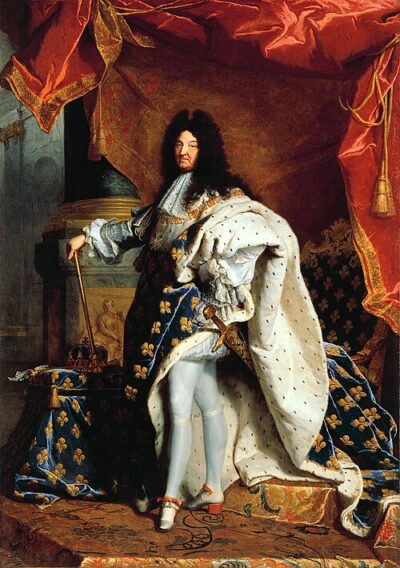
Louis XIV of France
Louis XIV of France was a King of France and Navarre from 1643 to 1715. Born September 5, 1638, in Château de Saint-Germain-en-Laye. Died September 1, 1715, in Palace of Versailles. Positions held include King of France and Navarre (1643–1715) and French co-prince of Andorra (1643–1715). Awards include Order of the Holy Spirit, Order of Saint Michael and Order of Saint Louis.
Facts
37 facts · 2 confirmed by two sources · 12 cited · 23 from one source
Where this comes from
Papalocal keeps its own record. It started from these sources; what each one said is kept here as it was copied, so a change on their side never changes this page by itself. Tap one to read its version.
What Wikidata says · copied November 16, 2026 · revision 2567772619
- Described as
- King of France and Navarre from 1643 to 1715 (1638-1715)
- Other names
- the Sun King, Louis le Grand Monarque, Louis XIV, Lewis the Fourteenth, Louis the Grand Monarch, Sun King, Lewis XIV, Louis le Grand, Louis the Great
- Born
- September 5, 1638 · 13 references
- Died
- September 1, 1715 · 13 references
- Born in
- Château de Saint-Germain-en-Laye · 1 reference
- Died in
- Palace of Versailles
- Buried in
- Basilica of Saint-Denis
- Cause of death
- gangrene
- Citizen of
- Kingdom of France
- Occupation
- politician; art collector · 1 reference; actor; monarch; statesperson
- Positions held
- King of France and Navarre (1643–1715); French co-prince of Andorra (1643–1715)
- Member of
- New Monarchs
- Awards
- Order of the Holy Spirit; Order of Saint Michael; Order of Saint Louis
- Spouse
- Maria Theresa of Spain (1660–1683) · 2 references; Françoise d'Aubigné, Marquise de Maintenon (1683–1715) · 2 references
- Children
- Louis, Grand Dauphin · 1 reference; Marie Thérèse, Madame Royale; Philippe Charles, Duke of Anjou · 1 reference; Princess Anne Élisabeth of France · 1 reference; Princess Marie Anne of France · 1 reference; Louis François, Duke of Anjou · 1 reference; Françoise Marie de Bourbon; Louise Françoise de Bourbon; Louis Auguste, Duke of Maine; Louis, Count of Vermandois; Louis César, Count of Vexin; Louise Marie Anne de Bourbon
- Father
- Louis XIII of France · 1 reference
- Mother
- Anne of Austria · 1 reference
- Siblings
- Philippe I, Duke of Orléans · 1 reference
- Religion
- Catholicism
- Lived in
- Palace of Versailles · 1 reference
- Wikipedias with a page
- 183
Wikidata item Q7742 (wikidata.org/wiki/Q7742), public domain (CC0). Copied November 16, 2026.
What Wikipedia says · copied November 16, 2026 · revision 1384355141
Louis XIV (Louis-Dieudonné; 5 September 1638 – 1 September 1715), known as the "Sun King", was King of France from 14 May 1643 until his death in 1715. He is the longest-reigning monarch in history, reigning for 72 years and 110 days. His reign brought about a golden age in French history, marked by a great expansion of the French colonial empire and a flourishing of French culture throughout Europe. As an absolute monarch, Louis expanded monarchical rule and diminished the power of the nobility, developing a strong centralised state ruled from the Palace of Versailles that persisted until the French Revolution.
Louis became king upon his father Louis XIII's death in 1643. Since he was too young to rule independently, he required a chief minister to rule in his place. His mother and regent, Anne of Austria, thus picked Cardinal Mazarin, who trained him in diplomacy and statecraft. Upon Mazarin's death in 1661, Louis had grown up and decided not to appoint a new chief minister. A believer in the divine right of kings, he sought to eliminate the remnants of feudalism persisting in parts of France by compelling many members of the nobility to reside at his lavish Palace of Versailles. In doing so, he succeeded in pacifying the aristocracy, many of whom had participated in the Fronde rebellions during his minority. Louis enforced uniformity of religion under the Catholic Church. His revocation of the Edict of Nantes abolished the rights of the Huguenot Protestant minority and subjected them to a wave of dragonnades, effectively forcing Huguenots to emigrate or convert, virtually destroying the French Protestant community.
During Louis' long reign, France emerged as the leading European power and regularly declared war. A conflict with Spain marked his entire childhood, while during his personal rule, Louis fought three major continental conflicts, each against powerful foreign alliances: the Franco-Dutch War, the Nine Years' War, and the War of the Spanish Succession. In addition, France contested shorter wars such as the War of Devolution and the War of the Reunions. Warfare defined Louis's foreign policy, impelled by his personal ambition for glory and power: "a mix of commerce, revenge, and pique". His wars strained France's resources to the utmost, while in peacetime he concentrated on preparing for the next war. He taught his diplomats that their job was to create tactical and strategic advantages for the French military. Upon his death in 1715, Louis XIV left his great-grandson and successor, Louis XV, a powerful but war-weary kingdom, in major debt after the War of the Spanish Succession that had raged on since 1701.Some of his other notable achievements include the construction of the 240 km (150 mi) Canal du Midi in Southern France, the patronage of artists (the playwrights Molière, Racine, the man of letters Boileau, the composer and dancer Lully, the painter Le Brun and the landscape architect Le Nôtre, all contributed to the apogee of French classicism, described during his lifetime as the "Grand Siècle", or even "the century of Louis XIV"), and the founding of the French Academy of Sciences.
- Born, in its opening lines
- September 5, 1638
- Died, in its opening lines
- September 1, 1715
From the Wikipedia article “Louis XIV” (en.wikipedia.org/wiki/Louis_XIV), by its contributors, under CC BY-SA 4.0 (creativecommons.org/licenses/by-sa/4.0/). Copied November 16, 2026; not changed.
Confirmed Two sources agree. Cited One source, and it names where it got it. One source One source, without a reference of its own. Sources disagree The sources disagree. We show the best-supported value and keep theirs below.
