
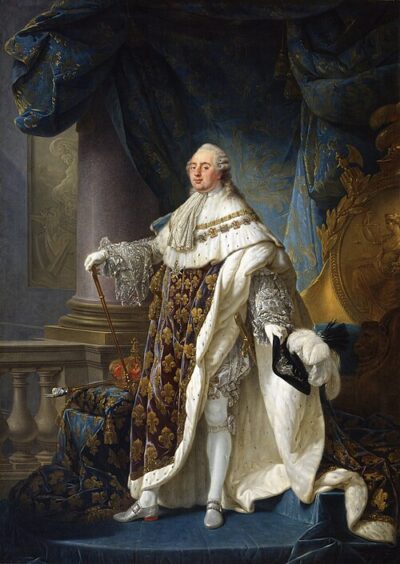
Louis XVI of France
Louis XVI of France was a King of France and Navarre from 1774 to 1791, then King of the French from 1791 to 1792. Born August 23, 1754, in Palace of Versailles. Died January 21, 1793, in place de la Concorde. Positions held include King of France and Navarre (1774–1791), King of the French (1791–1792) and French co-prince of Andorra (1774–1792). Awards include Knight of the Order of the Holy Spirit, Knight of the Order of Saint Michael and Knight of the Order of the Golden Fleece.
Facts
36 facts · 2 confirmed by two sources · 9 cited · 24 from one source · 1 where the sources disagree
What’s different
- Buried in: we show Madeleine Cemetery (Sources disagree). Wikidata also lists Basilica of Saint-Denis
Where this comes from
Papalocal keeps its own record. It started from these sources; what each one said is kept here as it was copied, so a change on their side never changes this page by itself. Tap one to read its version.
What Wikidata says · copied November 16, 2026 · revision 2563911304
- Described as
- King of France and Navarre from 1774 to 1791, then King of the French from 1791 to 1792 (1754-1793)
- Other names
- Louis I of Navarre, Louis XVI, Louis Capet
- Born
- August 23, 1754 · 11 references
- Died
- January 21, 1793 · 13 references
- Born in
- Palace of Versailles · 1 reference
- Died in
- place de la Concorde
- Buried in
- Basilica of Saint-Denis (1815–); Madeleine Cemetery · 1 reference
- Cause of death
- decapitation by guillotine
- Citizen of
- France
- Occupation
- politician; ruler; art collector · 1 reference; monarch
- Positions held
- King of France and Navarre (1774–1791); King of the French (1791–1792); French co-prince of Andorra (1774–1792); Grand Master of the Order of Our Lady of Mount Carmel and Saint Lazarus of Jerusalem (1757–1772) · 1 reference
- Member of
- Louis XVI and Marie Antoinette
- Awards
- Knight of the Order of the Holy Spirit; Knight of the Order of Saint Michael; Knight of the Order of the Golden Fleece (1761)
- Spouse
- Marie Antoinette (1770–1792) · 1 reference
- Children
- Marie Thérèse of France; Louis Joseph, Dauphin of France · 1 reference; Louis XVII of France · 1 reference; Princess Sophie of France · 1 reference
- Father
- Louis, Dauphin of France · 1 reference
- Mother
- Marie Josèphe of Saxony · 1 reference
- Siblings
- Marie Thérèse of France; Marie Zéphyrine of France; Xavier; Prince Louis, Duke of Burgundy; Louis XVIII of France · 1 reference; Charles X of France · 1 reference; Princess Élisabeth of France; Marie Clotilde of France
- Religion
- Catholicism
- Lived in
- Palace of Versailles · 1 reference
- Wikipedias with a page
- 126
Wikidata item Q7732 (wikidata.org/wiki/Q7732), public domain (CC0). Copied November 16, 2026.
What Wikipedia says · copied November 16, 2026 · revision 1380158075
Louis XVI (Louis-Auguste; French: [lwi sɛːz]; 23 August 1754 – 21 January 1793) was the last king of France before the fall of the monarchy during the French Revolution. The son of Louis, Dauphin of France (son and heir apparent of King Louis XV), and Maria Josepha of Saxony, Louis became the new Dauphin when his father died in 1765. In 1770, he married Austrian Archduchess Marie Antoinette. He became King of France and Navarre on his paternal grandfather's death on 10 May 1774, and reigned until the abolition of the monarchy on 21 September 1792. From 1791 onwards, he used the style of king of the French.
The first part of Louis XVI's reign was marked by attempts to reform the French government in accordance with Enlightenment ideas. These included efforts to increase tolerance toward non-Catholics as well as abolishing the death penalty for deserters. The French nobility reacted to the proposed reforms with hostility, and successfully opposed their implementation. Louis implemented deregulation of the grain market, advocated by his economic liberal minister Turgot, but it resulted in an increase in bread prices. In periods of bad harvests, it led to food scarcity which, during a particularly bad harvest in 1775, prompted the masses to revolt. From 1776, Louis XVI actively supported the North American colonists, who were seeking their independence from Great Britain, which was realised in the Treaty of Paris (1783). The ensuing debt and financial crisis contributed to the unpopularity of the ancien régime.
This led to the convening of the Estates General of 1789. Discontent among France's middle and lower classes intensified opposition to the French aristocracy and the absolute monarchy led by Louis XVI and his wife, Marie Antoinette. Tensions progressively rose, punctuated by violent riots such as the storming of the Bastille, which forced Louis to recognize the legislative authority of the National Assembly.
Louis's indecisiveness and conservatism toward the demands of the Estates led many to despise him as the embodiment of ancien régime tyranny, and his popularity deteriorated progressively. His unsuccessful flight to Varennes in June 1791 seemed to confirm suspicions that the king hoped for foreign intervention to restore his power, deeply undermining his legitimacy. Four months later, the constitutional monarchy was declared, and the replacement of the monarchy with a republic became an ever-increasing possibility. The growth of anti-clericalism among revolutionaries resulted in the abolition of the dîme (religious land tax) and several government policies aimed at the dechristianization of France.
With the outbreak of civil and international war, Louis XVI was arrested during the Insurrection of 10 August 1792. One month later, the monarchy was abolished and the French First Republic was proclaimed on 21 September 1792. The former king became a desacralized French citizen, addressed as Citoyen (Citizen) Louis Capet in reference to his ancestor Hugh Capet. Louis was tried by the National Convention (self-instituted as a tribunal for the occasion), found guilty of high treason, and executed by guillotine on 21 January 1793. Louis XVI's death brought an end to more than a thousand years of continuous French monarchy. Both of his sons died in childhood, before the Bourbon Restoration; his only child to reach adulthood, Marie Thérèse, was released to her Austrian relatives in exchange for French prisoners of war, eventually dying childless in 1851.
- Born, in its opening lines
- August 23, 1754
- Died, in its opening lines
- January 21, 1793
From the Wikipedia article “Louis XVI” (en.wikipedia.org/wiki/Louis_XVI), by its contributors, under CC BY-SA 4.0 (creativecommons.org/licenses/by-sa/4.0/). Copied November 16, 2026; not changed.
Confirmed Two sources agree. Cited One source, and it names where it got it. One source One source, without a reference of its own. Sources disagree The sources disagree. We show the best-supported value and keep theirs below.
