
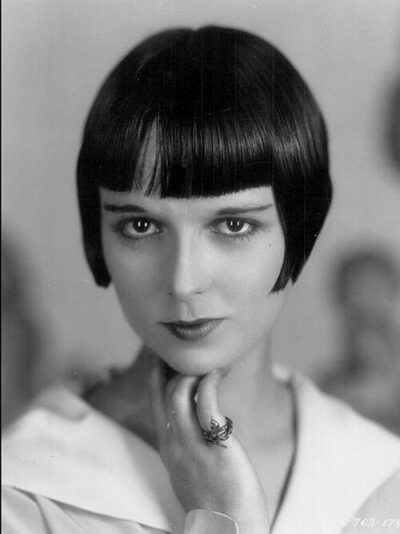
Louise Brooks
Louise Brooks was an American actress. Born November 14, 1906, in Cherryvale. Died August 8, 1985, in Rochester.
Facts
17 facts · 2 confirmed by two sources · 6 cited · 9 from one source
Where this comes from
Papalocal keeps its own record. It started from these sources; what each one said is kept here as it was copied, so a change on their side never changes this page by itself. Tap one to read its version.
What Wikidata says · copied November 13, 2026 · revision 2540431975
- Described as
- American actress (1906–1985)
- Other names
- Mary Louise Brooks
- Born
- November 14, 1906 · 12 references
- Died
- August 8, 1985 · 12 references
- Born in
- Cherryvale
- Died in
- Rochester · 1 reference
- Buried in
- Holy Sepulchre Cemetery · 1 reference
- Cause of death
- myocardial infarction
- Name at birth
- Mary Louise Brooks
- Citizen of
- United States
- Occupation
- actor · 1 reference; dancer · 1 reference; autobiographer; film actor; model · 1 reference; writer · 1 reference
- Field
- film · 1 reference
- Spouse
- A. Edward Sutherland (1926–1928); Deering Davis
- Wikipedias with a page
- 47
Wikidata item Q152779 (wikidata.org/wiki/Q152779), public domain (CC0). Copied November 13, 2026.
What Wikipedia says · copied November 13, 2026 · revision 1385241952
Mary Louise Brooks (November 14, 1906 – August 8, 1985) was an American film actress during the 1920s and 1930s, and later an essayist. She is regarded today as an icon of the flapper culture, in part due to the bob hairstyle that she helped popularize during the prime of her career.
Aged 15, Brooks began her career as a dancer and toured with the Denishawn School of Dancing and Related Arts where she performed opposite Ted Shawn. After being fired, she found employment as a chorus girl in George White's Scandals and as a semi-nude dancer in the Ziegfeld Follies in New York City. While dancing in the Follies, Brooks came to the attention of Walter Wanger, a producer at Paramount Pictures, and signed a five-year contract with the studio. She appeared in supporting roles in various Paramount films before taking the heroine's role in Beggars of Life (1928). During this time, she became an intimate friend of actress Marion Davies and joined the elite social circle of press baron William Randolph Hearst at Hearst Castle in San Simeon.
Dissatisfied with her mediocre roles in Hollywood films, Brooks went to Germany in 1929 and starred in three feature films that launched her to international stardom: Pandora's Box (1929), Diary of a Lost Girl (1929), and Miss Europe (Prix de Beauté) (1930); the first two were directed by G. W. Pabst. By 1938, she had starred in 14 silent films and 10 sound films. After retiring from acting, she fell upon financial hardship and became what she termed "a kept woman" to three wealthy men. For the next two decades, she was alcoholic and suicidal. Following the rediscovery of her films by cinephiles in the 1950s, a reclusive Brooks began writing articles about her film career; her insightful essays drew considerable acclaim. She published her memoir, Lulu in Hollywood, in 1982. Three years later, she died of a heart attack at age 78.
- Born, in its opening lines
- November 14, 1906
- Died, in its opening lines
- August 8, 1985
From the Wikipedia article “Louise Brooks” (en.wikipedia.org/wiki/Louise_Brooks), by its contributors, under CC BY-SA 4.0 (creativecommons.org/licenses/by-sa/4.0/). Copied November 13, 2026; not changed.
Confirmed Two sources agree. Cited One source, and it names where it got it. One source One source, without a reference of its own. Sources disagree The sources disagree. We show the best-supported value and keep theirs below.
