
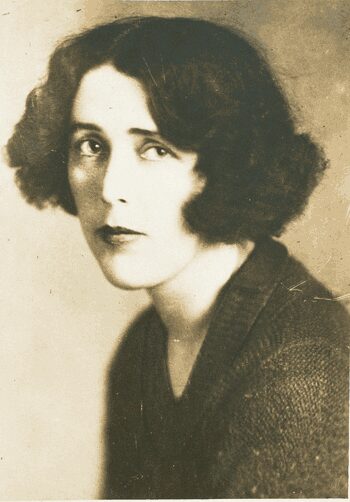
Louise Bryant
Louise Bryant was an American activist and journalist. Born December 5, 1885, in San Francisco. Died January 6, 1936, in Sèvres. Educated at University of Oregon and University of Nevada, Reno.
Facts
19 facts · 2 confirmed by two sources · 2 cited · 15 from one source
Where this comes from
Papalocal keeps its own record. It started from these sources; what each one said is kept here as it was copied, so a change on their side never changes this page by itself. Tap one to read its version.
What Wikidata says · copied November 15, 2026 · revision 2561124179
- Described as
- American activist and journalist (1885–1936)
- Other names
- Louise Mohan Bryant
- Born
- December 5, 1885 · 2 references
- Died
- January 6, 1936 · 2 references
- Born in
- San Francisco
- Died in
- Sèvres
- Buried in
- Cimetière des Gonards
- Cause of death
- cerebral hemorrhage
- Name at birth
- Anna Louise Mohan
- Citizen of
- United States · 1 reference
- Occupation
- journalist; writer; suffragette
- Education
- University of Oregon; University of Nevada, Reno
- Member of
- Silent Sentinels; National Woman's Party · 1 reference
- Spouse
- William Christian Bullitt, Jr.; John Reed; Paul Trullinger
- Children
- Anne Moen Bullitt
- Wikipedias with a page
- 34
Wikidata item Q267629 (wikidata.org/wiki/Q267629), public domain (CC0). Copied November 15, 2026.
What Wikipedia says · copied November 15, 2026 · revision 1377295781
Louise Bryant (December 5, 1885 – January 6, 1936) was an American feminist, political activist, and journalist best known for her sympathetic coverage of Russia and the Bolsheviks during the Russian Revolution of November 1917.
Born Anna Louise Mohan, she began as a young girl to use the last name of her stepfather, Sheridan Bryant, in preference to that of her father. She grew up in rural Nevada and attended the University of Nevada in Reno and the University of Oregon in Eugene, graduating with a degree in history in 1909. Pursuing a career in journalism, she became society editor of the Spectator and freelanced for The Oregonian, newspapers in Portland, Oregon. During her years in that city (1909–1915), she became active in the women's suffrage movement. Leaving her first husband in 1915 to follow fellow journalist John Reed (whom she married in 1916) to Greenwich Village, she formed friendships with leading feminists of the day, some of whom she met through Reed's associates at publications such as The Masses; at meetings of a women's group, Heterodoxy; and through work with the Provincetown Players. During a National Woman's Party suffrage-rally in Washington, D.C., in 1919 she was arrested and spent three days in jail. Both she and Reed took lovers outside their marriage; during her Greenwich Village years (1916–1920), these included the playwright Eugene O'Neill and the painter Andrew Dasburg.
In her 1917 coverage of the Russian Revolution, Bryant wrote about Russian leaders such as Catherine Breshkovsky, Maria Spiridonova, Alexander Kerensky, Vladimir Lenin, and Leon Trotsky. Her news stories, distributed by Hearst during and after her trips to Petrograd and Moscow, appeared in newspapers across the United States and Canada in the years immediately following World War I. A collection of articles from her first trip was published in 1918 as Six Red Months in Russia. Over the next year, she defended the revolution in testimony before the Overman Committee, a Senate subcommittee established in September 1918 to investigate foreign influence in the United States. Later in 1919, she undertook a nationwide speaking tour to encourage public support for the Bolsheviks and to denounce armed U.S. intervention in Russia.
After Reed's death from typhus in 1920, Bryant continued to write for Hearst about Russia, as well as Turkey, Hungary, Greece, Italy, and other countries in Europe and the Middle East. Some articles from this period were collected in 1923 under the title Mirrors of Moscow. Later that year, she married William C. Bullitt, Jr., with whom she had her only child, Anne, the following year. Diagnosed in her later years from the rare and painful disorder adiposis dolorosa, Bryant did little writing or publishing in her last decade, and drank heavily. Bullitt, winning sole custody of Anne, divorced Bryant in 1930. Bryant died in Paris in 1936 and was buried in Versailles. In 1998, a group from Portland restored her grave, which had become neglected.
- Born, in its opening lines
- December 5, 1885
- Died, in its opening lines
- January 6, 1936
From the Wikipedia article “Louise Bryant” (en.wikipedia.org/wiki/Louise_Bryant), by its contributors, under CC BY-SA 4.0 (creativecommons.org/licenses/by-sa/4.0/). Copied November 15, 2026; not changed.
Confirmed Two sources agree. Cited One source, and it names where it got it. One source One source, without a reference of its own. Sources disagree The sources disagree. We show the best-supported value and keep theirs below.
