
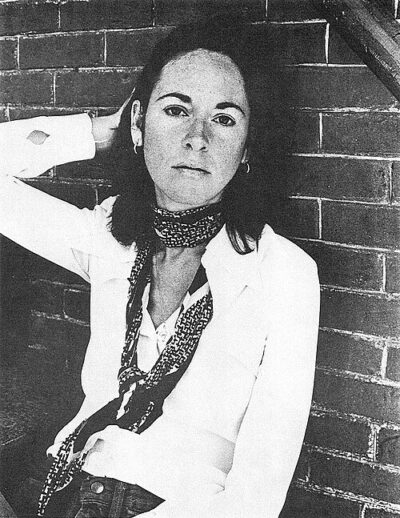
Louise Glück
Louise Glück was an U.S. poet and Nobel laureate. Born April 22, 1943, in New York City. Died October 13, 2023, in Cambridge. Known for Averno, Meadowlands and The Wild Iris. Educated at Columbia University and Sarah Lawrence College. Awards include Guggenheim Fellowship, Bollingen Prize and Pulitzer Prize for Poetry.
Facts
42 facts · 2 confirmed by two sources · 25 cited · 15 from one source
Where this comes from
Papalocal keeps its own record. It started from these sources; what each one said is kept here as it was copied, so a change on their side never changes this page by itself. Tap one to read its version.
What Wikidata says · copied November 13, 2026 · revision 2568215287
- Described as
- U.S. poet and Nobel laureate (1943–2023)
- Other names
- Louise Elisabeth Glück, Louise Gluck
- Born
- April 22, 1943 · 3 references
- Died
- October 13, 2023 · 3 references
- Born in
- New York City · 2 references
- Died in
- Cambridge · 1 reference
- Cause of death
- cancer · 1 reference
- Citizen of
- United States
- Occupation
- writer · 1 reference; poet · 2 references; essayist · 1 reference
- Worked for
- Yale University · 1 reference; Boston University; Williams College; University of Iowa · 1 reference
- Education
- Columbia University (1963–1966) · 1 reference; Sarah Lawrence College · 1 reference; George W. Hewlett High School · 1 reference
- Member of
- American Academy of Arts and Letters; American Academy of Arts and Sciences
- Known for
- Averno · 1 reference; Meadowlands · 1 reference; The Wild Iris; Faithful and Virtuous Night
- Awards
- Guggenheim Fellowship (1975) · 1 reference; Bollingen Prize (2001) · 1 reference; Pulitzer Prize for Poetry (1993); PEN New England Award (2007); United States Poet Laureate (2003–2004) · 1 reference; Eunice Tietjens Memorial Prize · 1 reference; National Endowment for the Arts Fellowship (3 times) (1970–1989); National Humanities Medal (2015) · 1 reference; Nobel Prize in Literature (2020) · 2 references; Lannan Literary Awards (1999) · 1 reference; Tomas Tranströmer prize (2020) · 1 reference; Wallace Stevens Award (2008) · 1 reference; National Book Critics Circle Award for Poetry (1985) · 1 reference; William Carlos Williams Award; National Book Award (2014) · 1 reference
- Field
- literary activity · 1 reference; poetry · 1 reference
- Spouse
- John Dranow (1977–1996) · 1 reference
- Children
- Noah Dranow
- Religion
- Judaism · 1 reference
- Wikipedias with a page
- 103
Wikidata item Q2344210 (wikidata.org/wiki/Q2344210), public domain (CC0). Copied November 13, 2026.
What Wikipedia says · copied November 13, 2026 · revision 1381601182
Louise Elisabeth Glück ( GLIK; April 22, 1943 – October 13, 2023) was an American poet and essayist. She won the 2020 Nobel Prize in Literature, whose judges praised "her unmistakable poetic voice that with austere beauty makes individual existence universal". Her other awards include the Pulitzer Prize, National Humanities Medal, National Book Award, National Book Critics Circle Award, and Bollingen Prize. From 2003 to 2004, she was Poet Laureate of the United States.
Glück was born in New York City and raised on Long Island. She began to suffer from anorexia nervosa while in high school and later overcame the illness. She attended Sarah Lawrence College and Columbia University but did not obtain a degree. In addition to being an author, she taught poetry at several academic institutions.
Glück is often described as an autobiographical poet; her work is known for its emotional intensity and for frequently drawing on mythology or nature imagery to meditate on personal experiences and modern life. Thematically, her poems have illuminated aspects of trauma, desire, and nature. In doing so, they have become known for frank expressions of sadness and isolation. Scholars have also focused on her construction of poetic personas and the relationship, in her poems, between autobiography and classical myth.
Glück served as the Frederick Iseman Professor in the Practice of Poetry at Yale University and as a professor of English at Stanford University. She split her time between Cambridge, Massachusetts; Montpelier, Vermont; and Berkeley, California.
- Born, in its opening lines
- April 22, 1943
- Died, in its opening lines
- October 13, 2023
From the Wikipedia article “Louise Glück” (en.wikipedia.org/wiki/Louise_Glück), by its contributors, under CC BY-SA 4.0 (creativecommons.org/licenses/by-sa/4.0/). Copied November 13, 2026; not changed.
Confirmed Two sources agree. Cited One source, and it names where it got it. One source One source, without a reference of its own. Sources disagree The sources disagree. We show the best-supported value and keep theirs below.
