
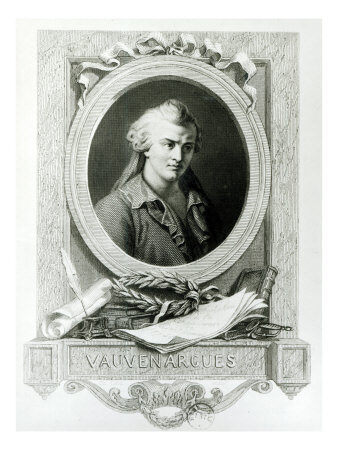
Luc de Clapiers, marquis de Vauvenargues
Luc de Clapiers, marquis de Vauvenargues was a French writer, a moralist. Born August 6, 1715, in Aix-en-Provence. Died May 28, 1747, in Paris. Educated at Collège des Jésuites.
Facts
11 facts · 2 confirmed by two sources · 3 cited · 6 from one source
Where this comes from
Papalocal keeps its own record. It started from these sources; what each one said is kept here as it was copied, so a change on their side never changes this page by itself. Tap one to read its version.
What Wikidata says · copied November 16, 2026 · revision 2558134313
- Described as
- French writer, a moralist (1715-1747)
- Other names
- Marquis de Vauvenargues, Lyuk de Klapye Vovenarq
- Born
- August 6, 1715 · 7 references
- Died
- May 28, 1747 · 9 references
- Born in
- Aix-en-Provence · 2 references
- Died in
- Paris · 2 references
- Citizen of
- France · 1 reference
- Occupation
- writer · 1 reference; essayist; military personnel · 1 reference; philosopher · 1 reference
- Education
- Collège des Jésuites
- Field
- philosophy
- Wikipedias with a page
- 57
Wikidata item Q551730 (wikidata.org/wiki/Q551730), public domain (CC0). Copied November 16, 2026.
What Wikipedia says · copied November 16, 2026 · revision 1362451538
Luc de Clapiers, marquis de Vauvenargues (French: [vovnaʁɡ]; 6 August 1715 – 28 May 1747) was a French writer and moralist. He died at age 31, in broken health, having published the year prior—anonymously—a collection of essays and aphorisms with the encouragement of Voltaire, his friend (20 years his senior). He first received public notice under his own name in 1797, and from 1857 on, his aphorisms became popular.
- Born, in its opening lines
- August 6, 1715
- Died, in its opening lines
- May 28, 1747
From the Wikipedia article “Luc de Clapiers, marquis de Vauvenargues” (en.wikipedia.org/wiki/Luc_de_Clapiers,_marquis_de_Vauvenargues), by its contributors, under CC BY-SA 4.0 (creativecommons.org/licenses/by-sa/4.0/). Copied November 16, 2026; not changed.
Confirmed Two sources agree. Cited One source, and it names where it got it. One source One source, without a reference of its own. Sources disagree The sources disagree. We show the best-supported value and keep theirs below.
