
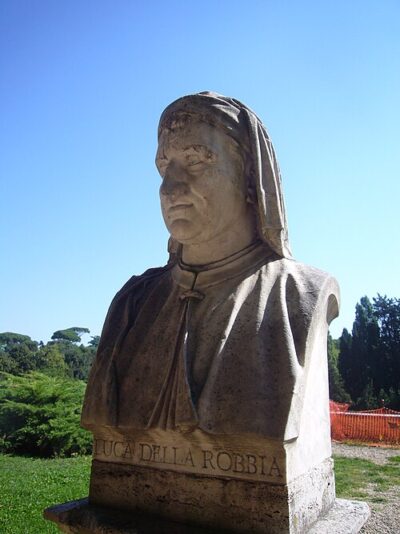
Luca della Robbia
Luca della Robbia was an Italian sculptor. Born July 1399, in Florence. Died February 10, 1482, in Florence. Known for Cantoria by Luca della Robbia, Cantoria by Donatello and Cross.
Facts
20 facts · 1 confirmed by two sources · 4 cited · 14 from one source · 1 where the sources disagree
What’s different
- Born: we show July 1399 (Sources disagree). Wikipedia says 1400
Where this comes from
Papalocal keeps its own record. It started from these sources; what each one said is kept here as it was copied, so a change on their side never changes this page by itself. Tap one to read its version.
What Wikidata says · copied November 16, 2026 · revision 2558134356
- Described as
- Italian sculptor (1399–1482)
- Other names
- Luca di Simone di Marco della Robbia, Luca di Simone di Marco, Luca di Simone della Robbia, Luca Della Robbia, Luca Di Simone Di Marco Della Robbia, Della Robbia, luca della robia, lucca della robbia, robbiawerkstatt, della Robbia, Luca Delia Robbia
- Born
- July 1399 · 1 reference
- Died
- February 10, 1482 · 2 references
- Born in
- Florence · 1 reference
- Died in
- Florence · 2 references
- Citizen of
- Republic of Florence
- Occupation
- sculptor · 2 references; ceramicist; artist · 1 reference
- Known for
- Cantoria by Luca della Robbia; Cantoria by Donatello; Cross · 1 reference; Head of a Young Man · 1 reference; Madonna and Child bust · 1 reference; Madonna and Child · 1 reference; Madonna and Child · 1 reference; Madonna of Santa Maria Nuova · 1 reference; Madonna with Child and Saints · 1 reference; Reliefs of the Giotto's Belltower by Luca of the Robbia · 1 reference
- Field
- art of sculpture
- Siblings
- Marco della Robbia
- Wikipedias with a page
- 41
Wikidata item Q194977 (wikidata.org/wiki/Q194977), public domain (CC0). Copied November 16, 2026.
What Wikipedia says · copied November 16, 2026 · revision 1330952094
Luca della Robbia (, also US: , Italian: [ˈluːka della ˈrobbja, - ˈrɔb-]; 1399/1400–1482) was an Italian Renaissance sculptor from Florence. Della Robbia is noted for his colorful, tin-glazed terracotta statuary, a technique that he invented and passed on to his nephew Andrea della Robbia and great-nephews Giovanni della Robbia and Girolamo della Robbia. Although a leading sculptor in stone, after developing his technique in the early 1440s he worked primarily in terracotta. His large workshop produced both less expensive works cast from molds in multiple versions, and more expensive one-off individually modeled pieces.
The vibrant, polychrome glazes made his creations both more expressive and more durable. His work is noted for its charm rather than the drama of the work of some of his contemporaries. Two of his famous works are The Nativity (c. 1460) and Madonna and Child (c. 1475). In stone, his most famous work is also his first major commission, the choir gallery, Cantoria in the Florence Cathedral (1431–1438).
Della Robbia was praised by his compatriot Leon Battista Alberti for genius comparable to that of the sculptors Donatello and Lorenzo Ghiberti, the architect Filippo Brunelleschi, and the painter Masaccio. By ranking him with contemporary artists of this stature, Alberti noted the interest and strength of Luca's work in marble and bronze, as well as in the terra-cottas always associated with his name.
- Born, in its opening lines
- 1400
- Died, in its opening lines
- 1482
From the Wikipedia article “Luca della Robbia” (en.wikipedia.org/wiki/Luca_della_Robbia), by its contributors, under CC BY-SA 4.0 (creativecommons.org/licenses/by-sa/4.0/). Copied November 16, 2026; not changed.
Confirmed Two sources agree. Cited One source, and it names where it got it. One source One source, without a reference of its own. Sources disagree The sources disagree. We show the best-supported value and keep theirs below.
