
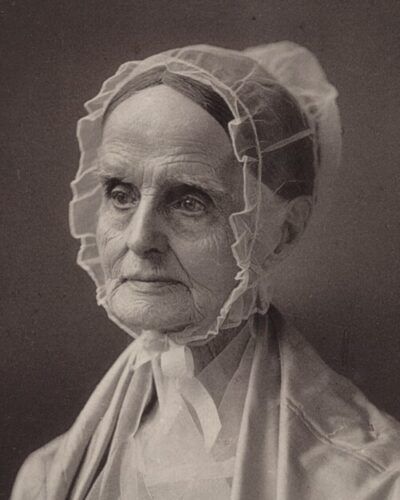
Lucretia Mott
Lucretia Mott was an American quaker missionary. Born January 3, 1793, in Nantucket. Died November 11, 1880, in Philadelphia. Educated at Oakwood Friends School. Awards include National Women's Hall of Fame.
Facts
25 facts · 2 confirmed by two sources · 6 cited · 17 from one source
Where this comes from
Papalocal keeps its own record. It started from these sources; what each one said is kept here as it was copied, so a change on their side never changes this page by itself. Tap one to read its version.
What Wikidata says · copied November 13, 2026 · revision 2565580433
- Described as
- American quaker missionary
- Other names
- Lucretia Coffin Mott, Lucretia C. Mott, Lucretia Coffin
- Born
- January 3, 1793 · 8 references
- Died
- November 11, 1880 · 7 references
- Born in
- Nantucket · 2 references
- Died in
- Philadelphia
- Buried in
- Fair Hill Burial Ground
- Cause of death
- pneumonia
- Citizen of
- United States
- Occupation
- women's rights activist; abolitionist; preacher; peace activist; teacher · 1 reference; writer · 1 reference; suffragist; feminist · 1 reference
- Education
- Oakwood Friends School · 1 reference
- Awards
- National Women's Hall of Fame (1983) · 1 reference
- Field
- abolitionism
- Spouse
- James Mott · 1 reference
- Children
- Maria Mott; Thomas Mott · 1 reference; Anna Mott Hopper
- Father
- Thomas Coffin
- Mother
- Anna Folger
- Siblings
- Martha Coffin Wright · 1 reference
- Wikipedias with a page
- 45
Wikidata item Q267107 (wikidata.org/wiki/Q267107), public domain (CC0). Copied November 13, 2026.
What Wikipedia says · copied November 13, 2026 · revision 1360497619
Lucretia Mott (born Coffin; January 3, 1793 – November 11, 1880) was an American Quaker, abolitionist, women's rights activist, and social reformer. She had formed the idea of reforming the position of women in society when she was amongst the women excluded from the World Anti-Slavery Convention held in London in 1840. In 1848, she was invited by Jane Hunt to a meeting that led to the first public gathering about women's rights, the Seneca Falls Convention, during which the Declaration of Sentiments was written.
Her speaking abilities made her an important abolitionist, feminist, and reformer; she had been a Quaker preacher early in her adulthood. She advocated giving black people, both male and female, the right to vote (suffrage). Her home, with husband the Quaker leader James Mott was a stop on the Underground Railroad. Mott helped found the Female Medical College of Pennsylvania and Swarthmore College and raised funds for the Philadelphia School of Design for Women. She remained a central figure in reform movements until her death in 1880. The area around her long-time residence in Cheltenham Township is now known as La Mott, in her honor.
- Born, in its opening lines
- January 3, 1793
- Died, in its opening lines
- November 11, 1880
From the Wikipedia article “Lucretia Mott” (en.wikipedia.org/wiki/Lucretia_Mott), by its contributors, under CC BY-SA 4.0 (creativecommons.org/licenses/by-sa/4.0/). Copied November 13, 2026; not changed.
Confirmed Two sources agree. Cited One source, and it names where it got it. One source One source, without a reference of its own. Sources disagree The sources disagree. We show the best-supported value and keep theirs below.
