
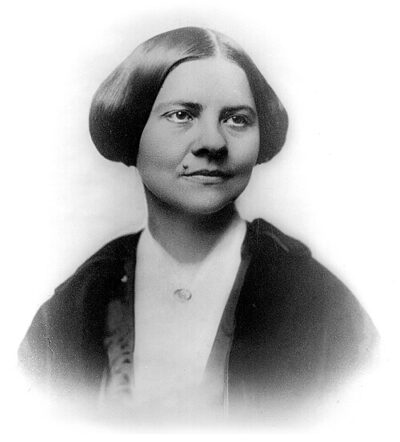
Lucy Stone
Lucy Stone was an American abolitionist and suffragist. Born August 13, 1818, in West Brookfield. Died October 18, 1893, in Dorchester. Educated at Oberlin College and Mount Holyoke College. Awards include National Women's Hall of Fame.
Facts
23 facts · 2 confirmed by two sources · 13 cited · 8 from one source
What’s different
- Died: we show October 18, 1893 (Confirmed). Wikidata also lists October 19, 1893
Where this comes from
Papalocal keeps its own record. It started from these sources; what each one said is kept here as it was copied, so a change on their side never changes this page by itself. Tap one to read its version.
What Wikidata says · copied November 13, 2026 · revision 2558949260
- Described as
- American abolitionist and suffragist (1818-1893)
- Other names
- Lucy Stone Blackwell
- Born
- August 13, 1818 · 6 references
- Died
- October 19, 1893 · 1 reference; October 18, 1893 · 1 reference
- Born in
- West Brookfield · 1 reference
- Died in
- Dorchester · 1 reference
- Buried in
- Forest Hills Cemetery · 1 reference
- Cause of death
- stomach cancer
- Citizen of
- United States
- Occupation
- journalist; women's rights activist · 1 reference; editor · 1 reference; abolitionist · 1 reference; suffragist; writer · 1 reference; feminist · 1 reference
- Education
- Oberlin College · 1 reference; Mount Holyoke College; Wilbraham & Monson Academy · 1 reference
- Awards
- National Women's Hall of Fame (1987) · 1 reference
- Spouse
- Henry Browne Blackwell (1855–1893) · 1 reference
- Children
- Alice Stone Blackwell · 1 reference
- Father
- Francis Stone, Jr. · 1 reference
- Siblings
- William B. Stone · 1 reference
- Religion
- congregationalist polity
- Wikipedias with a page
- 42
Wikidata item Q452281 (wikidata.org/wiki/Q452281), public domain (CC0). Copied November 13, 2026.
What Wikipedia says · copied November 13, 2026 · revision 1382248154
Lucy Stone (August 13, 1818 – October 18, 1893) was an American orator, abolitionist and suffragist who was a vocal advocate for and organizer of promoting rights for women. In 1847, Stone became the first woman from Massachusetts to earn a college degree. She spoke out for women's rights and campaigned against slavery. Stone was known for using her birth name, after marriage, contrary to the custom of women taking their husband's surname.
Stone's organizational activities for the cause of women's rights yielded tangible gains in the difficult political environment of the 19th century. Stone helped initiate the first National Women's Rights Convention in Worcester, Massachusetts, and she supported and sustained it, annually, along with a number of other local, regional, and state activist conventions. Stone spoke in front of a number of legislative bodies, to promote laws giving more rights to women. She assisted in establishing the Woman's National Loyal League to help pass the Thirteenth Amendment and thereby abolish slavery, after which she helped form the American Woman Suffrage Association (AWSA), which built support for a woman suffrage Constitutional amendment by winning woman suffrage at the local and state levels.
Stone wrote, extensively, about a wide range of women's rights, publishing and distributing speeches by herself and others, and convention proceedings. In the long-running and influential Woman's Journal, a weekly periodical that she founded and promoted, Stone aired both her own and differing views about women's rights. Called "the orator", the "morning star," and the "heart and soul" of the women's rights movement, Stone influenced Susan B. Anthony to take up the cause of women's suffrage. Elizabeth Cady Stanton wrote that "Lucy Stone was the first person by whom the heart of the American public was deeply stirred on the woman question." Together, Anthony, Stanton, and Stone have been called the 19th-century "triumvirate" of women's suffrage and feminism.
- Born, in its opening lines
- August 13, 1818
- Died, in its opening lines
- October 18, 1893
From the Wikipedia article “Lucy Stone” (en.wikipedia.org/wiki/Lucy_Stone), by its contributors, under CC BY-SA 4.0 (creativecommons.org/licenses/by-sa/4.0/). Copied November 13, 2026; not changed.
Confirmed Two sources agree. Cited One source, and it names where it got it. One source One source, without a reference of its own. Sources disagree The sources disagree. We show the best-supported value and keep theirs below.
