
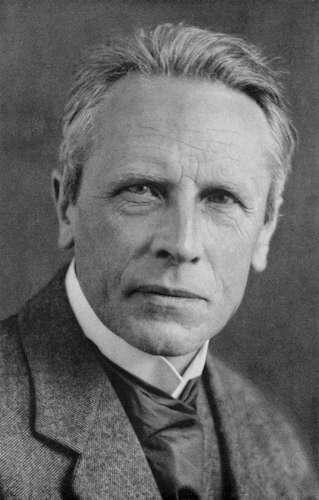
Ludwig Klages
Ludwig Klages was a German psychologist and philosopher. Born December 10, 1872, in Hanover. Died July 29, 1956, in Kilchberg. Educated at Leipzig University.
Facts
11 facts · 2 confirmed by two sources · 3 cited · 6 from one source
Where this comes from
Papalocal keeps its own record. It started from these sources; what each one said is kept here as it was copied, so a change on their side never changes this page by itself. Tap one to read its version.
What Wikidata says · copied November 17, 2026 · revision 2569066636
- Described as
- German psychologist and philosopher (1872–1956)
- Other names
- Friedrich Konrad Eduard Wilhelm Ludwig Klages
- Born
- December 10, 1872 · 5 references
- Died
- July 29, 1956 · 4 references
- Born in
- Hanover · 2 references
- Died in
- Kilchberg · 2 references
- Buried in
- Kilchberg cemetery · 1 reference
- Citizen of
- Germany
- Occupation
- psychologist · 1 reference; philosopher · 1 reference
- Education
- Leipzig University
- Member of
- Munich Cosmic Circle
- Field
- psychology
- Wikipedias with a page
- 27
Wikidata item Q60698 (wikidata.org/wiki/Q60698), public domain (CC0). Copied November 17, 2026.
What Wikipedia says · copied November 17, 2026 · revision 1379805639
Friedrich Konrad Eduard Wilhelm Ludwig Klages (German: [ˈklaːɡəs]; 10 December 1872 – 29 July 1956) was a German philosopher, psychologist, graphologist, poet, writer, and lecturer, who was a two-time nominee for the Nobel Prize in Literature. In the Germanosphere, he is considered one of the most important thinkers of the 20th century. He began his career as a research chemist according to his family's wishes, though soon returned to his passions for poetry, philosophy and classical studies. He held a post at the Ludwig-Maximilians-Universität München, where in 1905 he founded the Psychodiagnostisches Seminar; the latter was forced to close in 1914 with the outbreak of World War I. In 1915, Klages moved to neutral Switzerland, where over the following decades much of his mature philosophical works were written. Klages died in 1956.
Klages was a central figure of characterological psychology and the Lebensphilosophie school of thought. Prominent elements of his philosophy include: the opposition between life-affirming Seele and life-denying Geist; reality as the ongoing creation and interpretation of sensory images, rather than feelings; a biocentric ethics in response to modern ecological issues and militarism; an affirmation of eroticism in critique of both Christian patriarchy and the notion of the "sexual"; a theory of psychology focused on expression, including handwriting analysis; and a science of character aimed at reconciling the human ego to the divide it effectuates between living beings. Central to Klages's thought is a linguistic opposition to logocentrism, a term introduced by Klages to diagnose a fixation on language or words to the detriment of the things to which they refer. His formulation of this concept came to be of significant importance to semiotic studies of Western science and philosophy, namely within Derridean deconstruction. Klages is similarly seen as a forebear to critical theory, deep ecology, and existential phenomenology.
Klages's place in modern psychology has been likened to those of his contemporaries Sigmund Freud and Carl Jung. His philosophy was roundly attacked by Nazi leaders during the height of his career, though his proximity has since fallen to dispute. Though little of his literary output has historically been available in English, Klages's thought has exhibited sweeping influence on German developments in psychology, psychiatry, literature, and various other disciplines.
- Born, in its opening lines
- December 10, 1872
- Died, in its opening lines
- July 29, 1956
From the Wikipedia article “Ludwig Klages” (en.wikipedia.org/wiki/Ludwig_Klages), by its contributors, under CC BY-SA 4.0 (creativecommons.org/licenses/by-sa/4.0/). Copied November 17, 2026; not changed.
Confirmed Two sources agree. Cited One source, and it names where it got it. One source One source, without a reference of its own. Sources disagree The sources disagree. We show the best-supported value and keep theirs below.
