
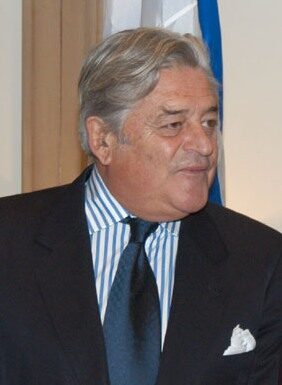
Luis Alberto Lacalle
Luis Alberto Lacalle is the 36th President of Uruguay. Born July 13, 1941, in Montevideo. Positions held include President of Uruguay (1990–1995). Educated at University of the Republic. Awards include Collar of the Order of Isabella the Catholic, Knight Grand Cross of the Order of St Michael and St George and Grand Collar of the Order of the Andes' Condor.
Facts
29 facts · 1 confirmed by two sources · 7 cited · 21 from one source
Where this comes from
Papalocal keeps its own record. It started from these sources; what each one said is kept here as it was copied, so a change on their side never changes this page by itself. Tap one to read its version.
What Wikidata says · copied November 16, 2026 · revision 2558137176
- Described as
- 36th President of Uruguay
- Other names
- Luis Alberto Lacalle de Herrera
- Born
- July 13, 1941 · 3 references
- Born in
- Montevideo · 2 references
- Citizen of
- Uruguay · 2 references; Spain
- Occupation
- lawyer; politician · 1 reference; journalist
- Positions held
- President of Uruguay (1990–1995)
- Political party
- National Party
- Education
- University of the Republic
- Member of
- Club of Rome
- Awards
- Collar of the Order of Isabella the Catholic (1992) · 1 reference; Knight Grand Cross of the Order of St Michael and St George (1993); Grand Collar of the Order of the Andes' Condor (1991); Grand Cross of the Order of the Southern Cross (1991); honorary doctor of the University of Madrid Complutense (1992) · 1 reference; Gold medal of Galicia (1994) · 1 reference; honorary doctor of the Hebrew University of Jerusalem; Grand Cross of the Order of Merit of the Republic of Poland; Medal of Military Merit (2011) · 2 references; Order of the Liberator General San Martín · 1 reference; National Order of Merit · 1 reference; Order of Merit · 1 reference; honorary doctor of Tel Aviv University (2017) · 1 reference
- Spouse
- María Julia Pou Brito del Pino · 1 reference
- Children
- Luis Lacalle Pou
- Father
- Carlos Pedro Lacalle Nuñez
- Mother
- María Hortensia de Herrera Uriarte
- Religion
- Catholicism
- Wikipedias with a page
- 37
Wikidata item Q336253 (wikidata.org/wiki/Q336253), public domain (CC0). Copied November 16, 2026.
What Wikipedia says · copied November 16, 2026 · revision 1378221050
Luis Alberto Lacalle de Herrera (Spanish pronunciation: [ˈlwis alˈβeɾto laˈkaʝe ðe eˈreɾa]; Lacalle locally [laˈkaʒe] or [laˈkaʃe]; born 13 July 1941) is a Uruguayan politician and lawyer who served as the 36th president of Uruguay from 1990 to 1995. A member of the National Party, he previously served as National Representative from 1972 to 1973, and as Senator of the Republic from 1985 to 1990.
Lacalle was born and raised in Montevideo. He is the grandson of Luis Alberto de Herrera who led the National Party and founded one of its most prominent sectors. He attended the Jesuit Colegio Seminario and graduated from the University of the Republic in 1964 with a law degree. In his youth he worked as a journalist in some media outlets. From 1972 to 1973 he served as National Representative for the Montevideo Department, but lost his seat after the dissolution of parliament with the coup d'état carried out by President Juan María Bordaberry.
Lacalle was elected president in the 1989 election, which marked only the third time since 1860 that his party had won a national election. It had last led the government when it formed a majority on the National Council of Government from 1959 to 1967, and last held the presidency via Bernardo Prudencio Berro from 1860 to 1865. His presidency was characterized by a liberal economic policy in line with the Washington Consensus. He carried out a fiscal adjustment and a reform to state-owned companies to deregulate them. This earned him opposition from the left and the union movement. In foreign policy, the Lacalle government signed the Treaty of Asunción that established the Southern Common Market (MERCOSUR).
After leaving office in 1995, Lacalle continued in active politics. In 1999 he ran for president again, finishing in third place. In 2004 he ran in the National Party presidential primaries, but was defeated by Jorge Larrañaga, who was the party's candidate in the general election. In 2009 he was a presidential candidate again but was defeated in the second round by the Broad Front nominee, José Mujica, who was elected president. With the victory of his son, Luis Lacalle Pou, in the 2019 general election, the two became the third father–son pair to serve as the nation's president.
- Born, in its opening lines
- July 13, 1941
From the Wikipedia article “Luis Alberto Lacalle” (en.wikipedia.org/wiki/Luis_Alberto_Lacalle), by its contributors, under CC BY-SA 4.0 (creativecommons.org/licenses/by-sa/4.0/). Copied November 16, 2026; not changed.
Confirmed Two sources agree. Cited One source, and it names where it got it. One source One source, without a reference of its own. Sources disagree The sources disagree. We show the best-supported value and keep theirs below.
