
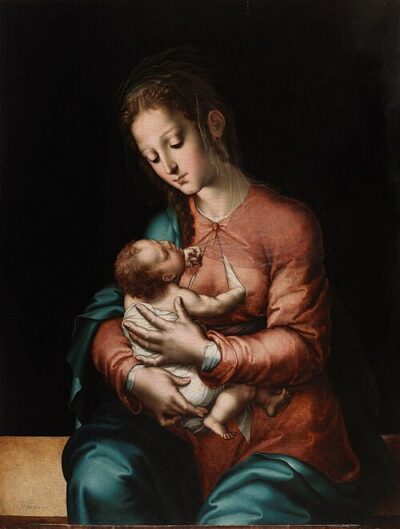
Luis de Morales was the 16th-century Spanish painter. Born 1509, in Badajoz. Died May 9, 1586, in Badajoz. Known for Ecce Homo.
Facts
9 facts · 2 confirmed by two sources · 6 cited · 1 from one source
Where this comes from
Papalocal keeps its own record. It started from these sources; what each one said is kept here as it was copied, so a change on their side never changes this page by itself. Tap one to read its version.
What Wikidata says · copied November 18, 2026 · revision 2567674290
- Described as
- 16th-century Spanish painter (1509–1586)
- Other names
- Divino, El Morales, Luis de Moralez, el Divino, Luis de Moralis, el divino Morales, Luis De Morales, Luis, 'El Divino' Morales, Luis de, el Divino Morales, Divino Morales, Morales, el Divino Morales, Moreles
- Born
- 1509 · 10 references
- Died
- May 9, 1586 · 4 references
- Born in
- Badajoz · 4 references
- Died in
- Badajoz · 5 references
- Citizen of
- Crown of Castile · 8 references
- Occupation
- painter · 9 references; artist · 1 reference; draftsperson · 1 reference
- Known for
- Ecce Homo · 1 reference
- Wikipedias with a page
- 22
Wikidata item Q703250 (wikidata.org/wiki/Q703250), public domain (CC0). Copied November 18, 2026.
What Wikipedia says · copied November 18, 2026 · revision 1383247899
Luis de Morales (1509 – 9 May 1586) was a Spanish painter active during the Spanish Renaissance in the 16th century. Known as "El Divino", most of his work was of religious subjects, including many representations of the Madonna and Child and the Passion.
Influenced by Raphael Sanzio and the Lombard school of Leonardo da Vinci, especially in his early work, he was called by his contemporaries "The Divine Morales" because of his skill and the shocking realism of his paintings, and because of the spirituality transmitted by all his work.
His work has been divided by critics into two periods, an early stage marked by the influence of Florentine artists such as Michelangelo, and a more intense, more anatomically correct later stage with similarities to the works of German and Flemish Renaissance painters. The Prado Museum in Madrid holds around 22 paintings by Morales. Some of his works can also be seen at Salamanca's Cathedral and Museum in Plasencia and the Real Academia de Bellas Artes de San Fernando in Madrid.
- Born, in its opening lines
- 1509
- Died, in its opening lines
- May 9, 1586
From the Wikipedia article “Luis de Morales” (en.wikipedia.org/wiki/Luis_de_Morales), by its contributors, under CC BY-SA 4.0 (creativecommons.org/licenses/by-sa/4.0/). Copied November 18, 2026; not changed.
Confirmed Two sources agree. Cited One source, and it names where it got it. One source One source, without a reference of its own. Sources disagree The sources disagree. We show the best-supported value and keep theirs below.
