
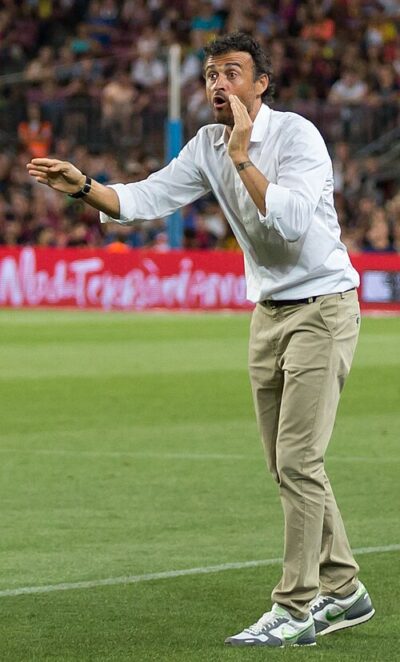
Luis Enrique
Luis Enrique is a Spanish footballer and manager. Born May 8, 1970, in Gijón. Teams include Real Madrid Club de Fútbol (1991–1996), Sporting de Gijón B (1988–1990) and FC Barcelona (1996–2004).
Facts
17 facts · 1 confirmed by two sources · 3 cited · 13 from one source
Where this comes from
Papalocal keeps its own record. It started from these sources; what each one said is kept here as it was copied, so a change on their side never changes this page by itself. Tap one to read its version.
What Wikidata says · copied November 16, 2026 · revision 2559434903
- Described as
- Spanish footballer and manager
- Other names
- Luis Enrique Martínez García, L. Enrique
- Born
- May 8, 1970 · 2 references
- Born in
- Gijón · 1 reference
- Name at birth
- Luis Enrique Martínez García
- Citizen of
- Spain
- Occupation
- association football player (–2004) · 1 reference; association football coach · 1 reference
- Teams
- Real Madrid Club de Fútbol (1991–1996); Sporting de Gijón B (1988–1990); FC Barcelona (1996–2004); Sporting de Gijón (1989–1991); Spain national under-21 association football team (1990–1991); Spain national under-23 football team (1991–1992); Spain men's national football team (1991–2002); Asturias autonomous football team (2000)
- Sport
- association football
- Height
- 1.80 m (5 ft 11 in)
- Website
- http://www.luisenrique21.com/
- Wikipedias with a page
- 68
Wikidata item Q222789 (wikidata.org/wiki/Q222789), public domain (CC0). Copied November 16, 2026.
What Wikipedia says · copied November 16, 2026 · revision 1384877804
Luis Enrique Martínez García (Spanish pronunciation: [lwis enˈrike maɾˈtineθ ɡaɾˈθia]; born 8 May 1970) is a Spanish football manager and former player who is the head coach of Ligue 1 club Paris Saint-Germain.
A versatile player with good technique, he was capable of playing in several positions but was usually deployed as a midfielder or forward, and was also noted for his temperament and stamina. Starting in 1988 and ending in 2004, he began his career at Sporting de Gijón and later represented both Real Madrid and Barcelona with both individual and team success, taking part in 558 official games and scoring 144 goals. He appeared with the Spain national team in three World Cups and Euro 1996.
Luis Enrique started working as a manager in 2008 with Barcelona B, before moving to Roma three years later. In the 2013–14 season, he managed Celta, before returning to Barcelona and winning the treble in his first year and the double in the second. In 2018, he was appointed Spain head coach for the first time before resigning for family reasons in 2019, but reassumed the position the same year and subsequently led the team to the semi-finals of Euro 2020 and to second place in the 2020–21 Nations League, resigning at the end of the 2022 World Cup. In July 2023, he joined French club Paris Saint-Germain, claiming three trophies in his first season and four in his second, including the first UEFA Champions League in their history, a title he retained the following campaign.
- Born, in its opening lines
- May 8, 1970
From the Wikipedia article “Luis Enrique” (en.wikipedia.org/wiki/Luis_Enrique), by its contributors, under CC BY-SA 4.0 (creativecommons.org/licenses/by-sa/4.0/). Copied November 16, 2026; not changed.
Confirmed Two sources agree. Cited One source, and it names where it got it. One source One source, without a reference of its own. Sources disagree The sources disagree. We show the best-supported value and keep theirs below.
