
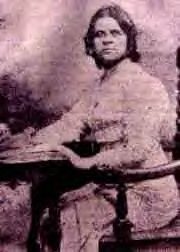
Luisa Capeta
Luisa Capeta was a Puerto Rican labor organizer. Born October 28, 1879, in Arecibo. Died April 10, 1922, in Río Piedras.
Facts
11 facts · 1 confirmed by two sources · 0 cited · 9 from one source · 1 where the sources disagree
What’s different
- Born: we show October 28, 1879 (Sources disagree). Wikipedia says October 28, 1882
Where this comes from
Papalocal keeps its own record. It started from these sources; what each one said is kept here as it was copied, so a change on their side never changes this page by itself. Tap one to read its version.
What Wikidata says · copied November 18, 2026 · revision 2522245438
- Described as
- Puerto Rican labor organizer (1879–1922)
- Other names
- Luisa Capetillo
- Born
- October 28, 1879
- Died
- April 10, 1922
- Born in
- Arecibo
- Died in
- Río Piedras
- Cause of death
- tuberculosis
- Citizen of
- United States
- Occupation
- writer; trade unionist; women's rights activist; suffragist; cigar factory reader
- Wikipedias with a page
- 16
Wikidata item Q515625 (wikidata.org/wiki/Q515625), public domain (CC0). Copied November 18, 2026.
What Wikipedia says · copied November 18, 2026 · revision 1371736393
Luisa Capetillo Perón (October 28, 1882 – April 10, 1922) was a Puerto Rican labor organizer, writer, journalist, and cigar factory reader. She organized workers in Puerto Rico, the Republic of Cuba, the Dominican Republic, and the United States. She also published four books in her lifetime, covering a wide variety of forms, genres, and topics. As an anarcha-feminist and social anarchist, she advocated for free love, universal education, women's rights, and collective ownership of scientific advances while opposing state control.
Capetillo was born in Arecibo, in the Captaincy General of Puerto Rico. Her father taught her to read and write, and she read extensively, including works by influential political thinkers. In 1897, she took Manuel Ledesma, the son of a wealthy aristocrat, as her lover. The two separated in 1900, but their relationship influenced her later feminist works. She began writing for the local newspaper in 1904, and in 1905, she became involved with the Free Federation of Workers (Spanish: Federación Libre de Trabajadores de Puerto Rico, FLT), an anarcho-syndicalist union, helping organize an agricultural strike in Arecibo. In 1906, she became a reader at a cigar factory, reading to the cigar makers as they worked and meeting members of the FLT-affiliated Federation of Tobacco Rollers (Spanish: Federación de Torcedores de Tabaco, FTT), becoming a leader in the FLT over time. Starting in 1912, she moved across the Atlantic and Caribbean, writing and organizing workers. In 1915, she was arrested in Cuba for wearing trousers and deported back to Puerto Rico. She continued to travel and organize until her death in 1922.
Interest in Capetillo's life surged in 1990 with the publication of the biography Luisa Capetillo, historia de una mujer proscrita (transl. Luisa Capetillo, History of an Outlawed Woman) by journalist Norma Valle Ferrer. After this, Capetillo became the subject of a docudrama series, and in 2014, the Legislative Assembly of Puerto Rico honored her with a plaque in the Plaza in Honor of Puerto Rican Women in San Juan. She is considered one of Puerto Rico's first feminists and, according to historian Jorrell A. Meléndez-Badillo, she was an influential node in an anarchist "counter-republic of letters": a network of writers who used their writing as a form of political struggle.
- Born, in its opening lines
- October 28, 1882
- Died, in its opening lines
- April 10, 1922
From the Wikipedia article “Luisa Capetillo” (en.wikipedia.org/wiki/Luisa_Capetillo), by its contributors, under CC BY-SA 4.0 (creativecommons.org/licenses/by-sa/4.0/). Copied November 18, 2026; not changed.
Confirmed Two sources agree. Cited One source, and it names where it got it. One source One source, without a reference of its own. Sources disagree The sources disagree. We show the best-supported value and keep theirs below.
