
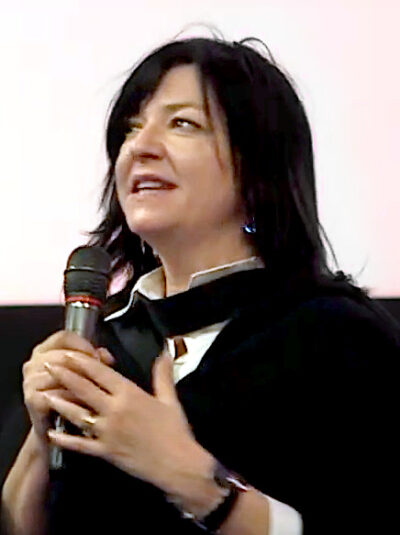
Lynne Ramsay
Lynne Ramsay is a Scottish film director, writer, producer, and cinematographer. Born December 5, 1969, in Glasgow. Educated at Edinburgh Napier University and National Film and Television School. Awards include Sutherland Trophy, BAFTA Award for Best Newcomer and BAFTA Award for Best Short Film.
Facts
13 facts · 1 confirmed by two sources · 6 cited · 6 from one source
Where this comes from
Papalocal keeps its own record. It started from these sources; what each one said is kept here as it was copied, so a change on their side never changes this page by itself. Tap one to read its version.
What Wikidata says · copied November 17, 2026 · revision 2558141933
- Described as
- Scottish film director, writer, producer, and cinematographer (born 1969)
- Born
- December 5, 1969 · 4 references
- Born in
- Glasgow · 2 references
- Citizen of
- United Kingdom
- Occupation
- film director · 1 reference; screenwriter · 1 reference; cinematographer · 1 reference; film producer · 3 references; director · 2 references
- Education
- Edinburgh Napier University; National Film and Television School
- Awards
- Sutherland Trophy (1999); BAFTA Award for Best Newcomer (2000); BAFTA Award for Best Short Film (2013)
- Wikipedias with a page
- 25
Wikidata item Q3269591 (wikidata.org/wiki/Q3269591), public domain (CC0). Copied November 17, 2026.
What Wikipedia says · copied November 17, 2026 · revision 1382455255
Lynne Ramsay (born 5 December 1969) is a Scottish filmmaker known for films such as Ratcatcher (1999), Morvern Callar (2002), We Need to Talk About Kevin (2011), You Were Never Really Here (2017), and Die My Love (2025). She has received numerous accolades. Her work is marked by a fascination with children, young people, and mothers, as well as the recurring themes of grief, guilt, death, and the aftermath of each.
- Born, in its opening lines
- December 5, 1969
From the Wikipedia article “Lynne Ramsay” (en.wikipedia.org/wiki/Lynne_Ramsay), by its contributors, under CC BY-SA 4.0 (creativecommons.org/licenses/by-sa/4.0/). Copied November 17, 2026; not changed.
Confirmed Two sources agree. Cited One source, and it names where it got it. One source One source, without a reference of its own. Sources disagree The sources disagree. We show the best-supported value and keep theirs below.
