
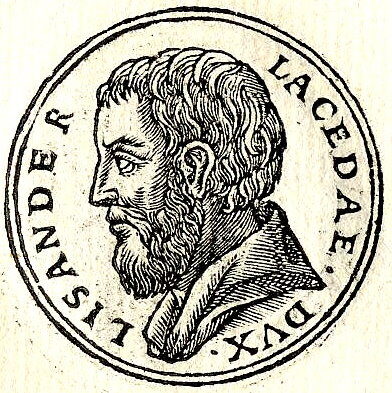
Lysander
Lysander was a Spartan military and political leader (died 395 BC). Born 5th century BC, in Sparta. Died 395 BC, in Haliartos. Positions held include strategos, navarch (-407–-406) and epistoleus (-405). Awards include apotheosis and honorific statue.
Facts
15 facts · 0 confirmed by two sources · 3 cited · 12 from one source
Where this comes from
Papalocal keeps its own record. It started from these sources; what each one said is kept here as it was copied, so a change on their side never changes this page by itself. Tap one to read its version.
What Wikidata says · copied November 16, 2026 · revision 2558141971
- Described as
- Spartan military and political leader (died 395 BC)
- Born
- 5th century BC · 1 reference
- Died
- 395 BC · 1 reference
- Born in
- Sparta
- Died in
- Haliartos
- Buried in
- Tomb of Lysander at Haliartos
- Citizen of
- Sparta
- Occupation
- politician; military personnel
- Positions held
- strategos; navarch (-407–-406); epistoleus (-405)
- Awards
- apotheosis · 1 reference; honorific statue · 1 reference
- Father
- Aristocritus
- Military rank
- admiral
- Wikipedias with a page
- 50
Wikidata item Q143559 (wikidata.org/wiki/Q143559), public domain (CC0). Copied November 16, 2026.
What Wikipedia says · copied November 16, 2026 · revision 1385826050
Lysander (; Ancient Greek: Λύσανδρος Lysandros; c. 454 BC – 395 BC) was a Spartan admiral and statesman who was one of the leading military and political figures of Sparta during the Peloponnesian War.
He destroyed the Athenian fleet at the Battle of Aegospotami in 405 BC, forcing Athens to capitulate and bringing the Peloponnesian Wars to an end. He then played a key role in Sparta's domination of Greece for the next decade until his death at the Battle of Haliartus in 395 BC.
Lysander's vision for Sparta differed from most Spartans; he wanted to overthrow the Athenian Empire and replace it with Spartan hegemony.
From the Wikipedia article “Lysander” (en.wikipedia.org/wiki/Lysander), by its contributors, under CC BY-SA 4.0 (creativecommons.org/licenses/by-sa/4.0/). Copied November 16, 2026; not changed.
Confirmed Two sources agree. Cited One source, and it names where it got it. One source One source, without a reference of its own. Sources disagree The sources disagree. We show the best-supported value and keep theirs below.
