
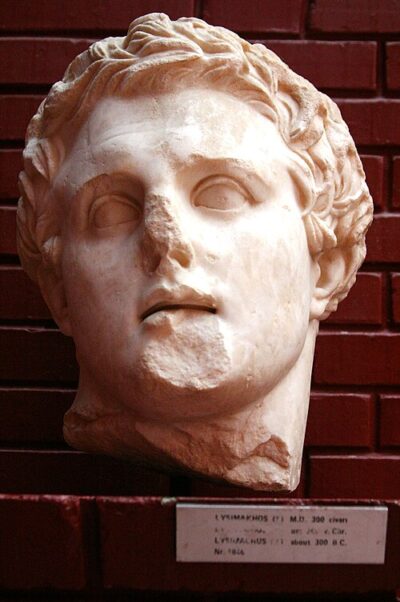
Lysimachus
Lysimachus was a Macedonian officer, one of Alexander's successor kings. Born 361 BC, in Pella. Died January 281 BC, in Curupedion. Positions held include somatophylakes, king and king of Macedonia (-288–-281).
Facts
29 facts · 0 confirmed by two sources · 2 cited · 25 from one source · 2 where the sources disagree
What’s different
- Born: we show 361 BC (Sources disagree). Wikidata also lists 355 BC
- Died: we show January 281 BC (Sources disagree). Wikidata also lists February 281 BC
Where this comes from
Papalocal keeps its own record. It started from these sources; what each one said is kept here as it was copied, so a change on their side never changes this page by itself. Tap one to read its version.
What Wikidata says · copied November 16, 2026 · revision 2568990386
- Described as
- Macedonian officer, one of Alexander's successor kings
- Born
- 361 BC · 1 reference; 355 BC · 1 reference
- Died
- January 281 BC · 1 reference; February 281 BC · 1 reference
- Born in
- Pella · 1 reference
- Died in
- Curupedion
- Buried in
- tomb of Lysimachos, between Kardia and Paktys · 1 reference
- Citizen of
- Macedonia; Thrace
- Occupation
- sovereign; politician; military personnel
- Positions held
- somatophylakes; king; king of Macedonia (-288–-281)
- Spouse
- Nicaea of Macedon; Amastris; Arsinoe II; Macris
- Children
- Arsinoe I; Agathocles; Eurydice; Ptolemy Epigonos; Lysimachus; Philip; Alexander · 1 reference; wife of Dromichaetes
- Father
- Agathocles of Pella
- Siblings
- Autodicus; Philip; Alcimachus of Apollonia
- Wikipedias with a page
- 51
Wikidata item Q32133 (wikidata.org/wiki/Q32133), public domain (CC0). Copied November 16, 2026.
What Wikipedia says · copied November 16, 2026 · revision 1381319375
Lysimachus ( ; Greek: Λυσίμαχος, Lysimachos; c. 360 BC – 281 BC) was a Thessalian officer and successor of Alexander the Great who became king of Thrace in 306 BC, western Asia Minor in 301 BC and Macedon in 288 BC.
Born into a Thessalian noble family, Lysimachus was one of Alexander's immediate bodyguards and accompanied him in his Persian and Indian campaigns. After Alexander's death in 323 BC, he was appointed strategos of Thrace. Afterwards, he joined a coalition against Antigonus, who was ultimately defeated and killed at the Battle of Ipsus in 301 BC. Antigonus's lands were divided among the victors, with Lysimachus acquiring Lydia, Ionia, Phrygia and northern Asia Minor. Later, he joined forces with Pyrrhus of Epirus to expel Antigonus's son Demetrius from Macedonia, before seizing Macedonia for himself.
The final years of Lysimachus's life were beset by domestic troubles. In 284 BC, urged by his third wife Arsinoe II, who sought to position her own son as successor, Lysimachus had his eldest son Agathocles executed on the charge of treason. The deeply unpopular act prompted widespread rebellion, and Seleucus seized the opportunity and invaded Asia Minor. In 281 BC, Lysimachus met Seleucus at the Battle of Corupedium, where he was defeated and killed.
From the Wikipedia article “Lysimachus” (en.wikipedia.org/wiki/Lysimachus), by its contributors, under CC BY-SA 4.0 (creativecommons.org/licenses/by-sa/4.0/). Copied November 16, 2026; not changed.
Confirmed Two sources agree. Cited One source, and it names where it got it. One source One source, without a reference of its own. Sources disagree The sources disagree. We show the best-supported value and keep theirs below.
