
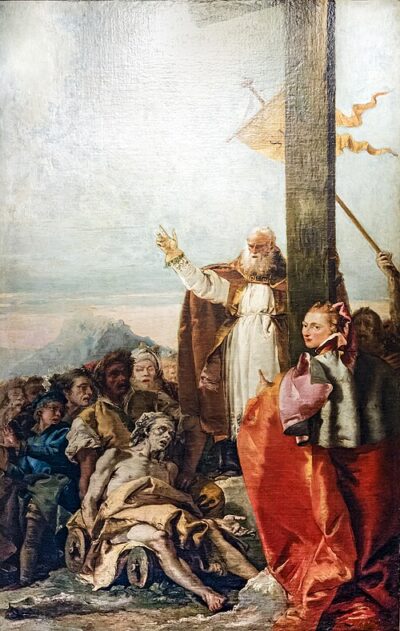
Macarius of Jerusalem
Macarius of Jerusalem was the 4th century Bishop of Jerusalem. Born 3rd century. Died 335, in Jerusalem. Positions held include bishop of Aelia Capitolina (314–325) and Greek Bishop of Jerusalem (325–333).
Facts
9 facts · 0 confirmed by two sources · 1 cited · 8 from one source
Where this comes from
Papalocal keeps its own record. It started from these sources; what each one said is kept here as it was copied, so a change on their side never changes this page by itself. Tap one to read its version.
What Wikidata says · copied November 18, 2026 · revision 2550730916
- Described as
- 4th century Bishop of Jerusalem
- Other names
- Macarius I, Saint Macarius of Jerusalem
- Born
- 3rd century
- Died
- 335
- Died in
- Jerusalem · 1 reference
- Citizen of
- Ancient Rome
- Occupation
- patriarch; bishop · 1 reference
- Positions held
- bishop of Aelia Capitolina (314–325); Greek Bishop of Jerusalem (325–333)
- Religion
- Christianity
- Wikipedias with a page
- 22
Wikidata item Q929275 (wikidata.org/wiki/Q929275), public domain (CC0). Copied November 18, 2026.
What Wikipedia says · copied November 18, 2026 · revision 1359662659
Macarius I (Greek: Μακάριος Α' Ἱεροσολύμων Makarios I Hierosolymōn) was Bishop of Jerusalem from 312 to shortly before 335, according to Sozomen. He is venerated as a saint within the Eastern Orthodox Church and Catholic Church.
Athanasius, in one of his orations against Arianism, refers to Macarius as an example of "the honest and simple style of apostolical men." The date 312 for Macarius's accession to the episcopate is found in Jerome's version of Eusebius of Caesarea's Chronicle.
About 325 he accompanied Helena Augusta, the mother of Constantine I in her search at Jerusalem for relics of the Passion of Jesus, including the cross on which Jesus of Nazareth was thought to have been crucified.
According to Eusebius, he received a long letter from Constantine with reference to the building of the Basilica of the Holy Sepulchre at Jerusalem: "Such is our Saviour's grace, that no power of language seems adequate to describe the wondrous circumstance to which I am about to refer. For, that the monument of his most holy Passion, so long ago buried beneath the ground, should have remained unknown for so long a series of years, until its reappearance to his servants now set free through the removal of him who was the common enemy of all, is a fact which truly surpasses all admiration ... And as to the columns and marbles, whatever you shall judge, after actual inspection of the plan, to be especially precious and serviceable, be diligent to send information to us in writing, in order that whatever quantity or sort of materials we shall esteem from your letter to be needful, may be procured from every quarter, as required, for it is fitting that the most marvelous place in the world should be worthily decorated."
Macarius is listed as one of the bishops to whom Pope Alexander of Alexandria wrote warning against Arius. His death must have been before the Council of Tyre, in 335, at which his successor, Maximus, was apparently one of the bishops present.
From the Wikipedia article “Macarius of Jerusalem” (en.wikipedia.org/wiki/Macarius_of_Jerusalem), by its contributors, under CC BY-SA 4.0 (creativecommons.org/licenses/by-sa/4.0/). Copied November 18, 2026; not changed.
Confirmed Two sources agree. Cited One source, and it names where it got it. One source One source, without a reference of its own. Sources disagree The sources disagree. We show the best-supported value and keep theirs below.
