
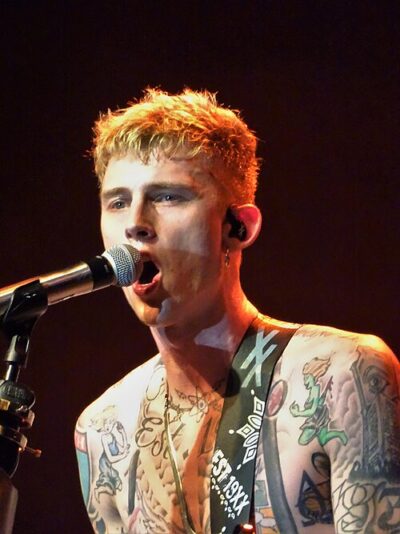
Machine Gun Kelly
Machine Gun Kelly is an American musician. Born April 22, 1990, in Houston. Educated at Chadwick International and Thomas Jefferson High School.
Facts
27 facts · 1 confirmed by two sources · 4 cited · 22 from one source
Where this comes from
Papalocal keeps its own record. It started from these sources; what each one said is kept here as it was copied, so a change on their side never changes this page by itself. Tap one to read its version.
What Wikidata says · copied November 13, 2026 · revision 2565748748
- Described as
- American musician (born 1990)
- Other names
- Colson Baker, MGK
- Born
- April 22, 1990
- Born in
- Houston
- Citizen of
- United States
- Occupation
- rapper · 1 reference; singer; songwriter; guitarist; actor · 2 references; television actor · 1 reference; musician · 1 reference; record producer
- Education
- Chadwick International; Thomas Jefferson High School; Shaker Heights High School
- Genre
- hip-hop; pop rap; rap rock; pop-punk; alternative rock; alternative hip-hop
- Instrument
- voice; guitar
- Record label
- Bad Boy Records; Interscope Records
- Lived in
- Los Angeles
- Height
- 1.96 m (6 ft 5 in)
- Website
- http://www.machinegunkelly.com/
- Wikipedias with a page
- 46
Wikidata item Q1354843 (wikidata.org/wiki/Q1354843), public domain (CC0). Copied November 13, 2026.
What Wikipedia says · copied November 13, 2026 · revision 1383846106
Colson Baker (born April 22, 1990), known professionally as MGK (stylized in all lowercase) and formerly Machine Gun Kelly, is an American rapper, singer, songwriter, producer, and actor. His original stage name "Machine Gun Kelly" was derived from the nickname of Prohibition-era gangster George Kelly Barnes.
MGK self-released four mixtapes from 2007 to 2010 before he signed with Sean Combs' Bad Boy Records, an imprint of Interscope Records, in 2011. His debut studio album, Lace Up (2012), peaked at number four on the US Billboard 200 and was led by the single "Wild Boy" (featuring Waka Flocka Flame), which marked his first entry on the Billboard Hot 100 and received triple platinum certification by the Recording Industry Association of America (RIAA). His second and third albums, General Admission (2015) and Bloom (2017), were both met with critical praise and similar commercial success; the latter was supported by the single "Bad Things" (with Camila Cabello), which peaked at number four on the Billboard Hot 100. His 2018 single, "Rap Devil", was a diss track aimed at fellow rapper Eminem, and peaked at number 13 on the chart despite mixed critical response. His fourth album, Hotel Diablo (2019), experimented with rap rock and saw a critical incline.
MGK's fifth album, Tickets to My Downfall (2020), waived any semblance of hip-hop in favor of a pop-punk sound and aesthetic, with its production entirely helmed by Blink-182 drummer Travis Barker. It debuted atop the Billboard 200—becoming the only rock album to do so that year—and was supported by the single "My Ex's Best Friend" (featuring blackbear), which peaked within the top 20 of the Billboard Hot 100. Its sequel, Mainstream Sellout (2022), served as his sixth album and matched its commercial success, although critical reception was mixed. In 2024, he released the collaborative extended play, (EP) Genre: Sadboy, with fellow Ohio-based rapper Trippie Redd, and delved into pop-rock with his seventh album, Lost Americana (2025).
MGK had his first starring role in the romantic drama Beyond the Lights (2014), and since appeared in the techno-thriller Nerve (2016), the horror Bird Box (2018), the comedy Big Time Adolescence and portrayed Tommy Lee in the Mötley Crüe biopic The Dirt (both 2019). In 2022, he and Mod Sun made their directorial debuts with the stoner comedy film Good Mourning, which they also wrote, produced, and starred in.
- Born, in its opening lines
- April 22, 1990
From the Wikipedia article “MGK” (en.wikipedia.org/wiki/MGK), by its contributors, under CC BY-SA 4.0 (creativecommons.org/licenses/by-sa/4.0/). Copied November 13, 2026; not changed.
Confirmed Two sources agree. Cited One source, and it names where it got it. One source One source, without a reference of its own. Sources disagree The sources disagree. We show the best-supported value and keep theirs below.
