
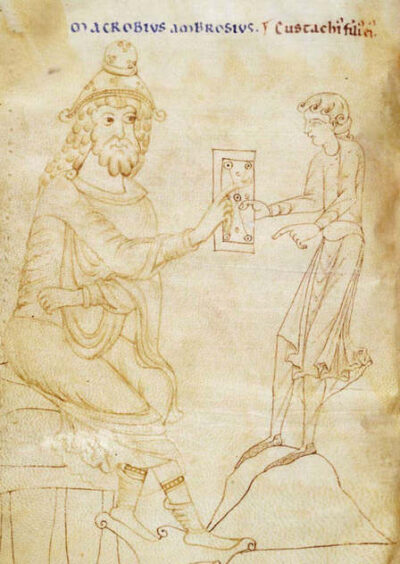
Macrobius
Macrobius was an ancient Roman author (5th century). Born 370, in Rome. Died 430. Positions held include praetorian prefecture of Italy (430). Known for Saturnalia.
Facts
15 facts · 0 confirmed by two sources · 7 cited · 7 from one source · 1 where the sources disagree
What’s different
- Born in: we show Rome (Sources disagree). Wikidata also lists Roman Africa
Where this comes from
Papalocal keeps its own record. It started from these sources; what each one said is kept here as it was copied, so a change on their side never changes this page by itself. Tap one to read its version.
What Wikidata says · copied November 16, 2026 · revision 2567822827
- Described as
- ancient Roman author (5th century)
- Other names
- Macrobius Ambrosius Theodosius, Ambrosius Theodosius Macrobius, Ambroise Théodose Macrobe
- Born
- 370 · 1 reference
- Died
- 430; 430 · 1 reference
- Born in
- Roman Africa; Rome · 1 reference
- Citizen of
- Ancient Rome
- Occupation
- philosopher · 1 reference; writer · 1 reference; civil servant; music theorist; philologist; poet · 1 reference; grammarian · 1 reference; scholar · 1 reference
- Positions held
- praetorian prefecture of Italy (430) · 1 reference
- Known for
- Saturnalia
- Children
- Macrobius Plotinus Eustathius
- Wikipedias with a page
- 46
Wikidata item Q313934 (wikidata.org/wiki/Q313934), public domain (CC0). Copied November 16, 2026.
What Wikipedia says · copied November 16, 2026 · revision 1385557269
Macrobius Ambrosius Theodosius, usually referred to as Macrobius (fl. c. AD 400), was a Roman provincial who lived during the early fifth century, during late antiquity, the period of time corresponding to the later Roman Empire, and when Latin was as widespread as Greek among the elite. He is primarily known for his writings, which include the widely copied and read Commentarii in Somnium Scipionis ("Commentary on the Dream of Scipio") about Somnium Scipionis, which was one of the most important sources for Neoplatonism in the Latin West during the Middle Ages; the Saturnalia, a compendium of ancient Roman religious and antiquarian lore; and De differentiis et societatibus graeci latinique verbi ("On the Differences and Similarities of the Greek and Latin Verb"), which is now lost.
From the Wikipedia article “Macrobius” (en.wikipedia.org/wiki/Macrobius), by its contributors, under CC BY-SA 4.0 (creativecommons.org/licenses/by-sa/4.0/). Copied November 16, 2026; not changed.
Confirmed Two sources agree. Cited One source, and it names where it got it. One source One source, without a reference of its own. Sources disagree The sources disagree. We show the best-supported value and keep theirs below.
