
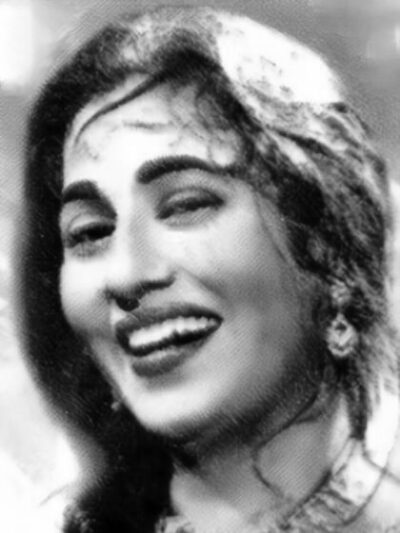
Madhubala
Madhubala was an Indian actress. Born February 14, 1933, in New Delhi. Died February 23, 1969, in Mumbai.
Facts
13 facts · 2 confirmed by two sources · 1 cited · 10 from one source
Where this comes from
Papalocal keeps its own record. It started from these sources; what each one said is kept here as it was copied, so a change on their side never changes this page by itself. Tap one to read its version.
What Wikidata says · copied November 16, 2026 · revision 2563972932
- Described as
- Indian actress (1933–1969)
- Other names
- Mumtaz Jehan Begum Dehlavi
- Born
- February 14, 1933 · 1 reference
- Died
- February 23, 1969 · 1 reference
- Born in
- New Delhi
- Died in
- Mumbai
- Cause of death
- cardiovascular disease
- Citizen of
- British Raj (–1947); Dominion of India (1947–1950); India (1950–)
- Occupation
- film actor; actor · 1 reference
- Spouse
- Kishore Kumar (1960–1969)
- Religion
- Islam
- Lived in
- Mumbai · 1 reference
- Wikipedias with a page
- 53
Wikidata item Q36881 (wikidata.org/wiki/Q36881), public domain (CC0). Copied November 16, 2026.
What Wikipedia says · copied November 16, 2026 · revision 1382069422
Mumtaz Jehan Begum Dehlavi (14 February 1933 – 23 February 1969), known professionally as Madhubala (pronounced [məd̪ʱubɑːlɑː]), was an Indian actress and film producer who was one of the leading stars of the Golden Age of Hindi cinema. She is known for her beauty and performances in dramatic, romantic and comedic roles. Although her beauty became central to her public image and earned her the nickname "Venus of the Indian screen", later critics have argued that her physical appeal often overshadowed her acting talent. Her portrayal of Anarkali in the historical epic Mughal-e-Azam (1960) has been named by critics as one of the finest performances in Indian cinematic history.
Born in Delhi, Madhubala migrated with her family to Bombay (now Mumbai) in her childhood. Her family's financial hardships led her to pursue a screen career as a child artiste, starting at the age of nine with Basant in 1942. She progressed to leading roles with the drama Neel Kamal (1947). Many of her early films received a lukewarm response, but the success of Lal Dupatta (1948) and the gothic film Mahal (1949) established her as a leading lady of Hindi cinema. By the early 1950s, she was one of India's highest-paid film stars, with commercially successful films such as Baadal and Tarana (both 1951).
Despite a mixed critical reception to many of her performances, Madhubala remained popular and sought more substantial acting roles. In 1954, she starred in the high-profile productions Bahut Din Huwe and Amar, and further co-founded her production company Madhubala Private Ltd., under which she produced and acted in Naata (1955). However, these films were unsuccessful at the box office, leading to a setback in her career. At a time when comedy was considered unsuitable for leading actresses, Madhubala's comic performances in Mr. & Mrs. '55 (1955) and Gateway of India (1957) earned her renewed critical and commercial success.
The period between 1958 and 1960 marked the peak of Madhubala's career, during which she starred in several of the highest-grossing films of their respective years. In 1958, she played a diverse range of roles in the thrillers Kala Pani and Howrah Bridge and the comedy Chalti Ka Naam Gaadi. In 1960, she starred in two of the decade's biggest commercial successes: the historical epic Mughal-e-Azam—then the highest-grossing Indian film—and the musical Barsaat Ki Raat. She worked only sporadically thereafter, appearing in films such as Half Ticket (1962) and Sharabi (1964), which marked her final screen appearance during her lifetime.
Known for maintaining a low public profile, Madhubala attracted considerable media attention for her personal life, including her relationship with Dilip Kumar and marriage to Kishore Kumar. She suffered from health complications caused by a ventricular septal defect throughout her adult life and died in 1969 at the age of 36. Decades after her death, Madhubala remains one of the most enduring figures of Hindi cinema, with her legacy influencing South Asian popular culture and receiving recognition in India and abroad.
- Born, in its opening lines
- February 14, 1933
- Died, in its opening lines
- February 23, 1969
From the Wikipedia article “Madhubala” (en.wikipedia.org/wiki/Madhubala), by its contributors, under CC BY-SA 4.0 (creativecommons.org/licenses/by-sa/4.0/). Copied November 16, 2026; not changed.
Confirmed Two sources agree. Cited One source, and it names where it got it. One source One source, without a reference of its own. Sources disagree The sources disagree. We show the best-supported value and keep theirs below.
