
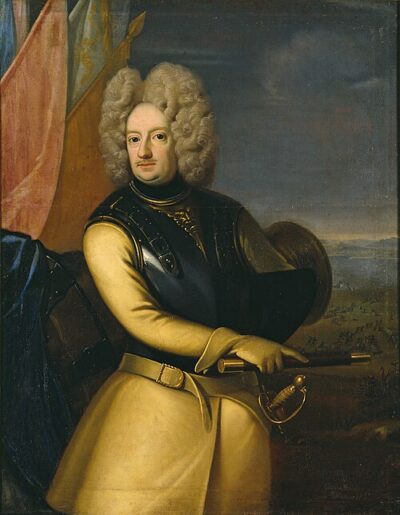
Magnus Stenbock
Magnus Stenbock was a Swedish noble. Born May 22, 1665, in Stockholm. Died February 23, 1717, in Copenhagen. Educated at Uppsala University.
Facts
21 facts · 2 confirmed by two sources · 10 cited · 9 from one source
What’s different
- Born: we show May 22, 1665 (Confirmed). Wikidata also lists May 12, 1665
Where this comes from
Papalocal keeps its own record. It started from these sources; what each one said is kept here as it was copied, so a change on their side never changes this page by itself. Tap one to read its version.
What Wikidata says · copied November 18, 2026 · revision 2568649352
- Described as
- Swedish noble (1664-1717)
- Other names
- Field Marshal, Greve Magnus Stenbock
- Born
- May 12, 1665; May 22, 1665
- Died
- February 23, 1717 · 3 references
- Born in
- Stockholm · 2 references
- Died in
- Copenhagen · 2 references
- Buried in
- Uppsala Cathedral
- Citizen of
- Sweden
- Occupation
- painter; military leader · 1 reference; soldier · 1 reference
- Education
- Uppsala University
- Spouse
- Eva Magdalena Oxenstierna (1690–)
- Children
- Gustaf Leonard Stenbock; Count Frederik Magnus von Stenbock · 1 reference; Ulrika Magdalena Stenbock · 1 reference; Grevinna Eva Charlotta Stenbock · 1 reference
- Father
- Gustaf Otto Stenbock · 1 reference
- Mother
- Christina Catharina De la Gardie · 1 reference
- Siblings
- Erik Gustaf Stenbock
- Military branch
- infantry · 1 reference
- Military rank
- fältmarskalk; general · 1 reference
- Wikipedias with a page
- 21
Wikidata item Q449530 (wikidata.org/wiki/Q449530), public domain (CC0). Copied November 18, 2026.
What Wikipedia says · copied November 18, 2026 · revision 1372047872
Count Magnus Stenbock (22 May 1665 – 23 February 1717) was a Swedish field marshal (Fältmarskalk) and Royal Councillor. A commander of the Carolean Army during the Great Northern War, he was a prominent member of the Stenbock family. He studied at Uppsala University and joined the Swedish Army during the Nine Years' War, participating in the Battle of Fleurus in 1690. After the battle, he was appointed lieutenant colonel, entered Holy Roman service as Adjutant General, and married Eva Magdalena Oxenstierna, daughter of statesman Bengt Gabrielsson Oxenstierna. Returning to Swedish service he received colonelcy of a regiment in Wismar, and later became colonel of the Kalmar and then Dalarna regiments.
During the Great Northern War, Stenbock served under King Charles XII in his military campaigns in the Baltic and Polish fronts. As director of the General War Commissariat, Stenbock collected substantial funds and supplies for the maintenance of the Swedish army, earning the admiration of Charles XII. In 1705, he was appointed general of the infantry and Governor General of Scania. As acting governor, Stenbock displayed his administrative skills and organized Scania's defense against an invading Danish army, which he defeated at the Battle of Helsingborg in 1710. In 1712, he conducted a campaign in northern Germany and defeated a Saxon-Danish army at the Battle of Gadebusch, which earned him his field marshal's baton. His career plummeted after his merciless destruction of the city of Altona in 1713. Surrounded by overwhelming allied troops, Stenbock was forced to surrender to King Frederick IV of Denmark during the siege of Tönning. During his captivity in Copenhagen, the Danes discovered Stenbock's escape attempt and imprisoned him in Kastellet. There he was the subject to a defamation campaign conducted by Frederick IV and died in 1717 after years of harsh treatment.
Besides his military and administrative professions, Stenbock was regarded as a skilled speaker, painter and craftsman. His military successes contributed to the creation of a heroic cult in Sweden. During the age of romantic nationalism he was consistently praised by Swedish historians and cultural personalities, such as Carl Snoilsky in his poem "Stenbock's courier". His name has inspired streets in several Swedish cities and in 1901 an equestrian statue of Stenbock was unveiled outside Helsingborg city hall.
- Born, in its opening lines
- May 22, 1665
- Died, in its opening lines
- February 23, 1717
From the Wikipedia article “Magnus Stenbock” (en.wikipedia.org/wiki/Magnus_Stenbock), by its contributors, under CC BY-SA 4.0 (creativecommons.org/licenses/by-sa/4.0/). Copied November 18, 2026; not changed.
Confirmed Two sources agree. Cited One source, and it names where it got it. One source One source, without a reference of its own. Sources disagree The sources disagree. We show the best-supported value and keep theirs below.
