
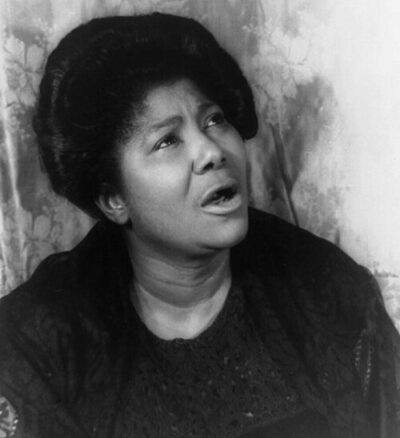
Mahalia Jackson
Mahalia Jackson was an American gospel singer. Born October 26, 1911, in New Orleans. Died January 27, 1972, in Evergreen Park. Awards include Grammy Lifetime Achievement Award, Gospel Music Hall of Fame and Grammy Award for Best Inspirational Performance.
Facts
25 facts · 2 confirmed by two sources · 7 cited · 16 from one source
Where this comes from
Papalocal keeps its own record. It started from these sources; what each one said is kept here as it was copied, so a change on their side never changes this page by itself. Tap one to read its version.
What Wikidata says · copied November 13, 2026 · revision 2558144461
- Described as
- American gospel singer (1911–1972)
- Other names
- The Queen of Gospel
- Born
- October 26, 1911 · 13 references
- Died
- January 27, 1972 · 11 references
- Born in
- New Orleans · 3 references
- Died in
- Evergreen Park · 1 reference
- Buried in
- Providence Memorial Park and Mausoleum · 1 reference
- Cause of death
- heart disease · 1 reference
- Citizen of
- United States
- Occupation
- gospel singer · 1 reference; musician · 1 reference; religious leader; singer · 1 reference
- Genre
- gospel music · 1 reference; spirituals · 1 reference
- Instrument
- voice
- Record label
- Decca; Apollo Records; Columbia Records
- Awards
- Grammy Lifetime Achievement Award (1972); Gospel Music Hall of Fame; Grammy Award for Best Inspirational Performance (1961); star on Hollywood Walk of Fame · 1 reference; Rock and Roll Hall of Fame (1997) · 1 reference; Order of Lincoln (1967) · 1 reference
- Religion
- Baptists
- Website
- http://www.mahaliajackson.us · 1 reference
- Wikipedias with a page
- 55
Wikidata item Q206466 (wikidata.org/wiki/Q206466), public domain (CC0). Copied November 13, 2026.
What Wikipedia says · copied November 13, 2026 · revision 1374135314
Mahalia Jackson ( mə-HAY-lee-ə; born Mahala Jackson; October 26, 1911 – January 27, 1972) was an American gospel singer, widely considered one of the most influential vocalists of the 20th century. With a career spanning 40 years, Jackson was integral to the development and spread of gospel blues in black churches throughout the U.S. During a time when racial segregation was pervasive in American society, she met considerable and unexpected success in a recording career, selling an estimated 22 million records and performing in front of integrated and secular audiences in concert halls around the world, making her one of the best-selling gospel music artists.
The granddaughter of enslaved people, Jackson was born and raised in poverty in New Orleans. She found a home in her church, leading to a lifelong dedication and singular purpose to deliver God's word through song. She moved to Chicago as an adolescent and joined the Johnson Singers, one of the earliest gospel groups. Jackson was heavily influenced by musician-composer Thomas Dorsey and blues singer Bessie Smith, adapting Smith's style to traditional Protestant hymns and contemporary songs. After making an impression in Chicago churches, she was hired to sing at funerals, political rallies, and revivals. For 15 years, she functioned as what she termed a "fish and bread singer", working odd jobs between performances to make a living.
Nationwide recognition came for Jackson in 1947 with the release of "Move On Up a Little Higher", selling two million copies and hitting the number-two spot on Billboard charts, both firsts for gospel music. Jackson's recordings captured the attention of jazz fans in the U.S. and France, and she became the first gospel recording artist to tour Europe. She regularly appeared on television and radio, and performed for many presidents and heads of state, including singing the national anthem at John F. Kennedy's Inaugural Ball in 1961. Motivated by her experiences living and touring in the South and integrating a Chicago neighborhood, she participated in the civil rights movement, singing for fundraisers and at the March on Washington for Jobs and Freedom in 1963. She was a vocal and loyal supporter of Martin Luther King Jr. and a personal friend of his family.
Throughout her career, Jackson faced intense pressure to record secular music, but she turned down high-paying opportunities to concentrate on gospel. Completely self-taught, Jackson had a keen instinct for music, her delivery marked by extensive improvisation with melody and rhythm. She was renowned for her powerful contralto voice, range, an enormous stage presence, and her ability to relate to her audiences, conveying and evoking intense emotion during performances. Passionate and at times frenetic, she wept and demonstrated physical expressions of joy while singing. Her success brought about international interest in gospel music, initiating the "Golden Age of Gospel" making it possible for many soloists and vocal groups to tour and record. Popular music as a whole felt her influence and she is credited with inspiring rhythm and blues, soul, and rock and roll singing styles. A Grammy Lifetime Achievement Award recipient, she won three competitive Grammy Awards and was inducted into the Grammy Hall of Fame, the National Recording Registry, and the Rock & Roll, Gospel, and R&B Halls of Fame, as well as the Hollywood Walk of Fame and Black Music & Entertainment Walk of Fame. She was also named one of NPR's 50 Great Voices, and ranked among Rolling Stone's 200 Greatest Singers of All Time.
- Born, in its opening lines
- October 26, 1911
- Died, in its opening lines
- January 27, 1972
From the Wikipedia article “Mahalia Jackson” (en.wikipedia.org/wiki/Mahalia_Jackson), by its contributors, under CC BY-SA 4.0 (creativecommons.org/licenses/by-sa/4.0/). Copied November 13, 2026; not changed.
Confirmed Two sources agree. Cited One source, and it names where it got it. One source One source, without a reference of its own. Sources disagree The sources disagree. We show the best-supported value and keep theirs below.
