
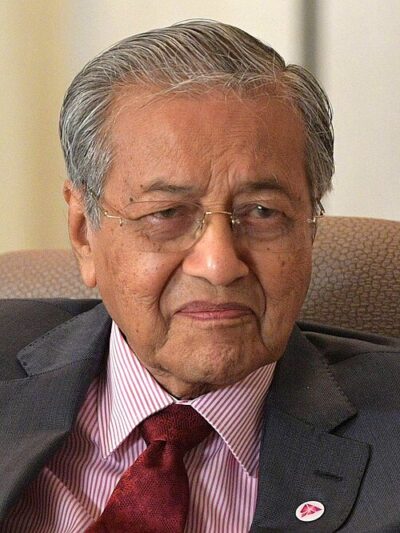
Mahathir Mohamad
Mahathir Mohamad is a Prime Minister of Malaysia (1981–2003, 2018–2020). Born July 10, 1925, in Alor Setar. Positions held include Prime Minister of Malaysia (2 times) (1981–2020), Deputy Prime Minister of Malaysia (1976–1981) and Minister of Defence (1981–1986). Known for The Malay Dilemma, A Doctor in the House: The Memoirs of Tun Dr. Mahathir Mohamad and The Malaysian Currency Crisis: How and Why It Happened. Educated at Universiti Malaya and National University of Singapore. Awards include Jawaharlal Nehru Award for International Understanding, Al-Gaddafi International Prize for Human Rights and King Faisal Prize in Service to Islam.
Facts
93 facts · 1 confirmed by two sources · 69 cited · 23 from one source
Where this comes from
Papalocal keeps its own record. It started from these sources; what each one said is kept here as it was copied, so a change on their side never changes this page by itself. Tap one to read its version.
What Wikidata says · copied November 16, 2026 · revision 2564646523
- Described as
- Prime Minister of Malaysia (1981–2003, 2018–2020)
- Other names
- Father of Modern Malaysia, Che Det, Datuk Seri Dr Mahathir Mohamad, Chedet, YABhg Tun Dr Mahathir Mohamad, Tun Dr Mahathir, Mahathir bin Mohamad, Dr. Mahathir bin Mohamad, Dr Mahathir bin Mohamad, Dr Mahathir Mohamad, Dr. Mahathir, Tun Dr. Mahathir Mohamad
- Born
- July 10, 1925 · 9 references
- Born in
- Alor Setar · 2 references
- Name at birth
- Mahathir bin Mohamad · 1 reference
- Citizen of
- Unfederated Malay States (–1957); Federation of Malaya (1957–1963); Malaysia (1963–)
- Occupation
- politician · 1 reference; physician · 1 reference; writer · 1 reference; autobiographer · 1 reference; head of government · 1 reference; adviser · 2 references; chancellor · 2 references; street vendor · 1 reference
- Positions held
- Prime Minister of Malaysia (2 times) (1981–2020) · 1 reference; Deputy Prime Minister of Malaysia (1976–1981) · 1 reference; Minister of Defence (1981–1986); Minister of Home Affairs (1986–1999); Minister of International Trade and Industry (1978–1981); Minister of Education (1974–1977); Member of the Dewan Negara (1972–1974); Secretary General of the Non-Aligned Movement (2003); member of the Dewan Rakyat · 2 references; Minister of Finance 2 (2 times) (1998–2003); Malaysian National Council for Islamic Religious Affairs chairman (2 times) (1981–2020)
- Political party
- United Malays National Organisation (2 times) (1947–2016) · 1 reference; Malaysian United Indigenous Party (2016–2020) · 1 reference; Homeland Fighter Party (2020–2023) · 1 reference; Parti Bumiputera Perkasa Malaysia (2023–) · 2 references
- Education
- Universiti Malaya (–1953) · 1 reference; National University of Singapore · 1 reference; Yong Loo Lin School of Medicine (1947–1953) · 1 reference; Sekolah Kebangsaan Seberang Perak (1930–1932) · 1 reference; Sultan Abdul Hamid College (2 times) (1933–1946)
- Member of
- Academy of Sciences Malaysia (1996–) · 1 reference; Ritsumeikan Asia Pacific University (1996–) · 1 reference; Perdana Leadership Foundation · 1 reference; Academy of Medicine of Malaysia (1983–) · 1 reference; Academy of Medicine, Singapore (1996–) · 1 reference; Malaysian Institute of Management (1984–) · 1 reference; Malaysian Medical Association · 1 reference; Islamic World Academy of Sciences · 1 reference; The International College of Surgeons (1996–) · 1 reference; Royal College of Physicians of Edinburgh (1997–) · 1 reference
- Sport
- rugby · 1 reference; cycling · 1 reference; equestrian sport · 2 references
- Known for
- The Malay Dilemma · 1 reference; A Doctor in the House: The Memoirs of Tun Dr. Mahathir Mohamad · 1 reference; The Malaysian Currency Crisis: How and Why It Happened; Reflections on Asia; A New Deal for Asia; Malay Women Make Their Own Freedom · 1 reference
- Awards
- Jawaharlal Nehru Award for International Understanding (1996) · 2 references; Al-Gaddafi International Prize for Human Rights (2005) · 1 reference; King Faisal Prize in Service to Islam (1997) · 1 reference; Commander of the National Order of the Cedar; Grand Cordon of the Order of the Paulownia Flowers (2018) · 1 reference; Grand Cross of the Order of Good Hope (1997) · 2 references; Grand Cross of the Order of Merit of the Republic of Poland (2002) · 1 reference; doctor honoris causa of Keiō University (2004) · 1 reference; honorary doctor of Waseda University (2005) · 1 reference; honorary doctor of the Tsinghua University (2004) · 1 reference; Commander of the Order of the Polar Star (1996) · 1 reference; Nishan-e-Pakistan (2019) · 2 references; Order of the White Elephant (1981) · 1 reference; Order of Sultan Mahmud I of Terengganu (1982) · 1 reference; Order of Loyalty to the Royal House of Kedah (1977)
- Field
- politics · 1 reference; medicine · 1 reference
- Spouse
- Siti Hasmah Mohamad Ali (1956–2026) · 3 references
- Children
- Marina Mahathir · 2 references; Mokhzani Mahathir · 2 references; Mukhriz Mahathir · 2 references; Mirzan Mahathir · 2 references; Melinda Mahathir · 2 references; Mazhar Mahathir · 2 references; Maizura Mahathir · 1 reference
- Father
- Mohamad Iskandar · 2 references
- Mother
- Wan Tempawan Wan Hanapi · 4 references
- Siblings
- Habsah Mohamad · 2 references; Murad Mohamad; Rafeah Mohamad · 2 references; Mashahor Mohamad · 1 reference; Omar Mohamad; Johora Mohamad; Mustaffa Mohamad; Mahadi Mohamad · 1 reference
- Religion
- Sunni Islam · 2 references
- Lived in
- Seri Kembangan · 2 references
- Nickname
- Father of Modern Malaysia · 1 reference
- Height
- 1.70 m (5 ft 7 in) · 2 references
- Website
- https://thechedet.com
- Wikipedias with a page
- 162
Wikidata item Q181383 (wikidata.org/wiki/Q181383), public domain (CC0). Copied November 16, 2026.
What Wikipedia says · copied November 16, 2026 · revision 1384137053
Mahathir bin Mohamad (Jawi: محاضر بن محمد; Malay: [mahade(r) muhammad, -ðe(r)] ; born 10 July 1925) is a Malaysian politician, physician and author who served as the fourth and seventh prime minister of Malaysia from 1981 to 2003 and again from 2018 to 2020. He was the country's longest-serving prime minister, serving for a cumulative total of 24 years. His political career has spanned more than 75 years, from joining protests opposing citizenship policies for non-Malays in the Malayan Union in the 1940s to forming the Gerakan Tanah Air coalition in 2022. During his premiership, Mahathir was granted the title "Father of Modernisation" (Malay: Bapa Pemodenan) for his pivotal role in transforming the country's economy and infrastructure. At 101 years old, he is the second-oldest living former state leader in the world and the first Malaysian prime minister to reach that age.
Born and raised in Alor Setar, Kedah, Mahathir excelled at school and became a physician. He became active in UMNO before entering the parliament of Malaysia in 1964 as the Member of Parliament for Kota Setar Selatan, serving until he lost his seat in 1969, subsequently falling out with Prime Minister Tunku Abdul Rahman and being expelled from UMNO. In 1970, he released the book The Malay Dilemma. When Tunku resigned, Mahathir re-entered UMNO and parliament through Kubang Pasu constituency, and was promoted to Minister of Education from 1974 to 1978 and Minister of Trade and Industry from 1978 to 1981. He became deputy prime minister in 1976 before being sworn in as prime minister in 1981.
During Mahathir's first tenure from 1981 to 2003, Malaysia experienced significant economic growth and modernisation, with his government promoting industry-wide privatisation and initiating major infrastructure projects, such as the North–South Expressway and the Kuala Lumpur City Centre. His policies were credited with transforming Malaysia into one of Southeast Asia's most dynamic emerging economies. He was a dominant political figure, securing five consecutive general election victories and maintaining leadership of the UMNO despite internal challenges. Mahathir continued pro-bumiputera policies and oversaw Malaysia's relatively swift recovery from the 1997 Asian financial crisis, aided by capital controls and stimulus measures that diverged from IMF prescriptions. As prime minister, he was a strong proponent of Asian values and alternative development models, and he played a prominent role in the Muslim world.
In 1987, he ordered the detention of numerous activists under Operation Lalang, and his administration was involved in the 1988 Malaysian constitutional crisis, which raised concerns about judicial independence. He supported a constitutional amendment that stripped the royalty of criminal immunity, a move widely regarded as a legal reform strengthening the rule of law. In 1998, the dismissal of deputy Anwar Ibrahim sparked the Reformasi and became a major point of political debate in Malaysia. Critics accused Mahathir of authoritarianism for centralising power and suppressing dissent, while supporters argued that his actions were necessary to preserve national stability.
Mahathir resigned in 2003 after 22 years in office, but remained politically influential and was critical of his successors. He quit UMNO over the 1MDB corruption scandal in 2016, joining BERSATU and leading the Pakatan Harapan opposition coalition to victory in the 2018 general election. During a second tenure as prime minister, he pledged to investigate the 1MDB scandal, combat corruption, and cut spending on large infrastructure projects. He also secured the pardon and release of Anwar Ibrahim. Mahathir resigned in 2020 amidst a political crisis. Despite losing his parliamentary seat in the 2022 general election, he remained active in politics and shifted party affiliation several times. In 2019, Time magazine listed him as one of the world's 100 most influential people. Mahathir's political views have shifted during his life, and are shaped by his Malay nationalism and Islamic religious beliefs.
- Born, in its opening lines
- July 10, 1925
From the Wikipedia article “Mahathir Mohamad” (en.wikipedia.org/wiki/Mahathir_Mohamad), by its contributors, under CC BY-SA 4.0 (creativecommons.org/licenses/by-sa/4.0/). Copied November 16, 2026; not changed.
Confirmed Two sources agree. Cited One source, and it names where it got it. One source One source, without a reference of its own. Sources disagree The sources disagree. We show the best-supported value and keep theirs below.
