
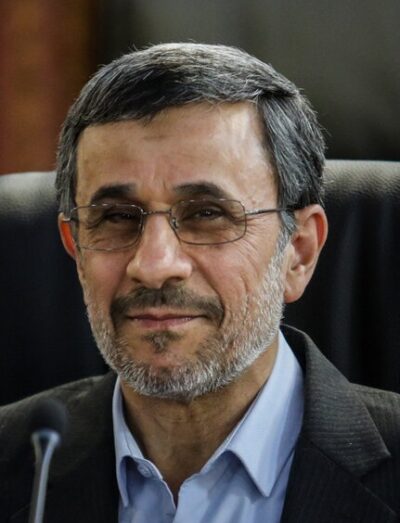
Mahmoud Ahmadinejad
Mahmoud Ahmadinejad is the 6th President of the Islamic Republic of Iran from 2005 to 2013. Born October 28, 1956, in Aradan. Positions held include Mayor of Tehran (2003–2005), President of Iran (2005–2013) and Secretary General of the Non-Aligned Movement (2012–2013). Educated at Iran University of Science and Technology. Awards include Order of Islamic Revolution, Order of the Liberator and Orden de la Independencia Cultural Rubén Darío.
Facts
29 facts · 1 confirmed by two sources · 9 cited · 19 from one source
Where this comes from
Papalocal keeps its own record. It started from these sources; what each one said is kept here as it was copied, so a change on their side never changes this page by itself. Tap one to read its version.
What Wikidata says · copied November 16, 2026 · revision 2568954793
- Described as
- 6th President of the Islamic Republic of Iran from 2005 to 2013
- Other names
- Mahmūd Ahmadinezhād, Mahmoud Ahmedinejad
- Born
- October 28, 1956 · 6 references
- Born in
- Aradan
- Citizen of
- Iran
- Occupation
- university teacher; engineer · 1 reference; head of state · 1 reference; politician · 2 references
- Positions held
- Mayor of Tehran (2003–2005); President of Iran (2005–2013); Secretary General of the Non-Aligned Movement (2012–2013); Minister of Intelligence (Iran) (2009); Minister of Petroleum of Iran (2011); Governor of Ardabil Province (1993–1997)
- Political party
- Alliance of Builders of Islamic Iran; Society of Devotees of the Islamic Revolution
- Worked for
- Iran University of Science and Technology
- Education
- Iran University of Science and Technology (1975–)
- Awards
- Order of Islamic Revolution (2005) · 1 reference; Order of the Liberator (2006) · 1 reference; Orden de la Independencia Cultural Rubén Darío (2007) · 1 reference; Order of Augusto César Sandino (2007) · 1 reference; Honorary doctor of Lebanese University (2010) · 1 reference; honorary doctor of the University of Havana (2012) · 1 reference; Grand Cross of the National Order of Benin (2013) · 1 reference
- Spouse
- Azam Farahi (1980–)
- Father
- Ahmad Ahmadinejad
- Mother
- Fatemeh Beygom Ghaderi
- Religion
- Shia Islam
- Lived in
- Tehran
- Wikipedias with a page
- 146
Wikidata item Q34448 (wikidata.org/wiki/Q34448), public domain (CC0). Copied November 16, 2026.
What Wikipedia says · copied November 16, 2026 · revision 1382204141
Mahmoud Ahmadinejad (né Sabbaghian; born 28 October 1956) is an Iranian politician who served as the president of Iran from 2005 to 2013. Ideologically a principlist and nationalist, he was a member of the Expediency Discernment Council. He was also the main political leader of the Alliance of Builders of Islamic Iran, a coalition of conservative political groups in the country, and served as the mayor of Tehran from 2003 to 2005, reversing many of his predecessor's reforms.
An engineer and teacher from a poor family, he was ideologically shaped by thinkers such as Navvab Safavi, Jalal Al-e-Ahmad, and Ahmad Fardid. After the Iranian Revolution, Ahmadinejad joined the Office for Strengthening Unity. Appointed a provincial governor in 1993, he was replaced along with all other provincial governors in 1997 after the election of President Mohammad Khatami and returned to teaching. Tehran's council elected him mayor in 2003. He took a religious hard line, reversing reforms of previous moderate mayors. His 2005 presidential campaign, supported by the Alliance of Builders of Islamic Iran, garnered 62% of the runoff election votes, and he became president on 3 August 2005.
During his presidency, Ahmadinejad was a controversial figure both in Iran and worldwide. He was criticized domestically for his economic policies, and was accused of disregard for human rights by organizations in North America and Europe. Outside of Iran, he was criticized for his hostility towards Israel, Saudi Arabia, the United Kingdom, the United States and other Western and Arab states. In 2007, Ahmadinejad introduced a gasoline rationing plan to reduce the country's fuel consumption and cut the interest rates that private and public banking facilities could charge. His election to a second term in 2009 was widely disputed, and led to widespread protests domestically and criticism from Western countries. He repeatedly called for the destruction of Israel. He also declared the Holocaust to be a myth, later claiming that promoting Holocaust denial was one of the major achievements of his presidency. He was a strong proponent of Iran's nuclear program.
During his second term, Ahmadinejad experienced a power struggle with reformers and other traditionalists in Parliament and the Revolutionary Guard, as well as with Supreme Leader Ali Khamenei, over his dismissal of intelligence minister Gholam-Hossein Mohseni-Eje'i and his support for his controversial close adviser, Esfandiar Rahim Mashaei. On 14 March 2012, Ahmadinejad became the first president of the Islamic Republic of Iran to be summoned by the Islamic Consultative Assembly (parliament) to answer questions regarding his presidency. Limited to two terms under the current Iranian constitution, Ahmadinejad supported Mashaei's campaign for president. In 2013, Hassan Rouhani was elected as Ahmadinejad's successor.
On 12 April 2017, Ahmadinejad announced that he intended to run for a third term in the 2017 presidential election, against the objections of Supreme Leader Khamenei. His nomination was rejected by the Guardian Council. During the 2017–18 Iranian protests, Ahmadinejad criticized the current government of Iran. He made additional attempts at registering to run for the 2021 presidential election and 2024 Iranian presidential election, but his nominations were rejected.
In July 2026, it was reported that the Central Intelligence Agency and Mossad initially planned to re-install Ahmadinejad as Iranian president as part of regime change Operations Epic Fury and Roaring Lion, which has since fallen through.
- Born, in its opening lines
- October 28, 1956
From the Wikipedia article “Mahmoud Ahmadinejad” (en.wikipedia.org/wiki/Mahmoud_Ahmadinejad), by its contributors, under CC BY-SA 4.0 (creativecommons.org/licenses/by-sa/4.0/). Copied November 16, 2026; not changed.
Confirmed Two sources agree. Cited One source, and it names where it got it. One source One source, without a reference of its own. Sources disagree The sources disagree. We show the best-supported value and keep theirs below.
