
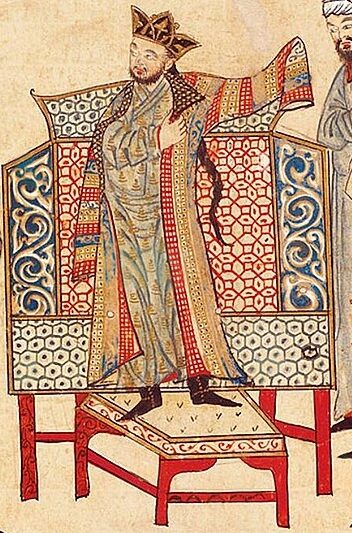
Mahmud of Ghazni
Mahmud of Ghazni was a Sultan of the Ghaznavid Empire from 998 to 1030. Born November 2, 971, in Ghazni. Died April 30, 1030, in Ghazni. Positions held include Sultan of the Ghaznavid Empire (998–1030).
Facts
12 facts · 1 confirmed by two sources · 2 cited · 8 from one source · 1 where the sources disagree
What’s different
- Born: we show November 2, 971 (Sources disagree). Wikipedia says October 2, 971
Where this comes from
Papalocal keeps its own record. It started from these sources; what each one said is kept here as it was copied, so a change on their side never changes this page by itself. Tap one to read its version.
What Wikidata says · copied November 16, 2026 · revision 2565554648
- Described as
- Sultan of the Ghaznavid Empire from 998 to 1030
- Other names
- Yamīn ad-Dawlah Abul-Qāṣim Maḥmūd Ibn Sebüktegīn, Sultan Mahmood Ghaznavi, Mahmud of Ghazna
- Born
- November 2, 971 · 1 reference
- Died
- April 30, 1030 · 1 reference
- Born in
- Ghazni
- Died in
- Ghazni · 1 reference
- Occupation
- king
- Positions held
- Sultan of the Ghaznavid Empire (998–1030)
- Children
- Mas'ud I · 1 reference; Mohammad Ghaznavi; Abd al-Rashid ben Mahmud
- Father
- Sabuktigin · 1 reference
- Siblings
- Ismail of Ghazni
- Religion
- Sunni Islam
- Wikipedias with a page
- 66
Wikidata item Q189271 (wikidata.org/wiki/Q189271), public domain (CC0). Copied November 16, 2026.
What Wikipedia says · copied November 16, 2026 · revision 1383817248
Abu al-Qasim Mahmud ibn Sabuktigin (Persian: ابوالقاسم محمود بن سبکتگین, romanized: Abu al-Qāṣim Maḥmūd ibn Sabuktigīn; 2 October 971 – 30 April 1030), commonly known as Mahmud of Ghazni or Mahmud Ghaznavi (محمود غزنوی), was the Sultan of the Ghaznavid Empire, ruling from 998 to 1030. Mahmud was known by his honorific title Yamin al-Dawla (یمین الدوله, lit. 'Right Hand of the State'). At the time of his death, his kingdom had been transformed into an extensive military empire, which extended from present-day northwestern Iran proper to the Punjab in the Indian subcontinent and Khwarazm in Transoxiana.
Highly Persianized, Mahmud continued the bureaucratic, political, and cultural customs of his predecessors, the Samanids. He ascended the throne at the age of 27 upon his father's death, albeit after a brief war of succession with his brother Ismail. He was the first ruler to hold the title Sultan ("authority"), signifying the extent of his power while at the same time preserving an ideological link to the suzerainty of the Abbasid caliphs. He laid the foundation of Muslim rule into core of the Indian subcontinent. As a champion of Sunni Islam, Mahmud waged war against the non-Muslim states in Indian subcontinent as well as Shi'a states within his empire and bordering regions of Iran. In the thirty-two years of his reign, he made thirty-five major and eleven minor campaigns and reputed to be undefeated throughout his entire military career.
Mahmud established the ground for a future Persianate state in Punjab, particularly centered on Lahore, a city he conquered. His capital of Ghazni evolved into a significant cultural, commercial, and intellectual centre in the Islamic world, almost rivalling the important city of Baghdad. The capital appealed to many prominent figures, such as al-Biruni and Ferdowsi.
- Born, in its opening lines
- October 2, 971
- Died, in its opening lines
- April 30, 1030
From the Wikipedia article “Mahmud of Ghazni” (en.wikipedia.org/wiki/Mahmud_of_Ghazni), by its contributors, under CC BY-SA 4.0 (creativecommons.org/licenses/by-sa/4.0/). Copied November 16, 2026; not changed.
Confirmed Two sources agree. Cited One source, and it names where it got it. One source One source, without a reference of its own. Sources disagree The sources disagree. We show the best-supported value and keep theirs below.
