
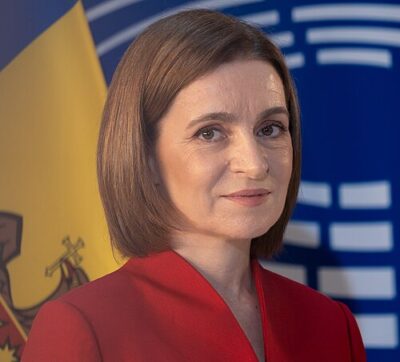
Maia Sandu
Maia Sandu is a President of Moldova since 2020. Born May 24, 1972, in Risipeni. Positions held include member of the Parliament of Moldova (2019), Prime Minister of Moldova (2019) and President of Moldova (2020–). Educated at Academy of Economic Studies of Moldova and Academy of Public Administration of Moldova. Awards include GPSA Award for Leadership in Social Accountability, Order of Labour, 1st class and Order of Prince Yaroslav the Wise, 1st class.
Facts
25 facts · 1 confirmed by two sources · 7 cited · 17 from one source
Where this comes from
Papalocal keeps its own record. It started from these sources; what each one said is kept here as it was copied, so a change on their side never changes this page by itself. Tap one to read its version.
What Wikidata says · copied November 16, 2026 · revision 2567844225
- Described as
- President of Moldova since 2020
- Born
- May 24, 1972 · 2 references
- Born in
- Risipeni
- Name at birth
- Maia Sandu
- Citizen of
- Moldova · 1 reference; Romania (2009–) · 2 references; Soviet Union (–1991)
- Occupation
- economist · 1 reference; politician · 1 reference
- Positions held
- member of the Parliament of Moldova (2019); Prime Minister of Moldova (2019); President of Moldova (2020–); chairperson (2016–2020)
- Political party
- Party of Action and Solidarity (2016–2020); Liberal Democratic Party of Moldova · 1 reference
- Education
- Academy of Economic Studies of Moldova (–1994); Academy of Public Administration of Moldova (1995–1998); John F. Kennedy School of Government (–2010)
- Awards
- GPSA Award for Leadership in Social Accountability (2015); Order of Labour, 1st class; Order of Prince Yaroslav the Wise, 1st class · 1 reference; Grand Cross of the Legion of Honour (2024); Franz Josef Strauss Award (2025); Honourable Member of the European Order of Merit (2026) · 1 reference; Order of Princess Olga, 1st class (2026) · 1 reference
- Religion
- Moldovan Orthodox Church
- Wikipedias with a page
- 98
Wikidata item Q15071069 (wikidata.org/wiki/Q15071069), public domain (CC0). Copied November 16, 2026.
What Wikipedia says · copied November 16, 2026 · revision 1378226915
Maia Sandu (Romanian: [ˈmaja ˈsandu]; born 24 May 1972) is a Moldovan politician and economist who, since 2020, has served as the sixth president of Moldova. She is the founder and former leader of the Party of Action and Solidarity (PAS) and was prime minister of Moldova from June to November 2019, when her government collapsed after a vote of no-confidence. Sandu was minister of education from 2012 to 2015 and member of the parliament of Moldova from 2014 to 2015, and again in 2019.
Sandu was elected president of Moldova during the 2020 Moldovan presidential election. The first female president of Moldova, Sandu is a strong supporter of the accession of Moldova to the European Union, overseeing Moldova's granting of candidate status, and is widely considered "pro-Western". She has criticised and opposed Russia's invasion of Ukraine and supported subsequent steps to reduce Moldova's economic dependence on Russia, frequently expressing sympathy and support for Ukraine in the conflict. Sandu has made anti-corruption, economic reform and liberalisation a central part of her political platform, as well as closer integration with Europe. In February 2023, she accused Russia of seeking to stage a coup of the Moldovan government and has continued to seek to reduce Russia's influence over the country.
Sandu was re-elected president in the 2024 Moldovan presidential election following an electoral campaign defined by geopolitical issues, such as the referendum on amending the constitution to include the desire for EU membership, as well as an unprecedented level of Russian electoral interference.
- Born, in its opening lines
- May 24, 1972
From the Wikipedia article “Maia Sandu” (en.wikipedia.org/wiki/Maia_Sandu), by its contributors, under CC BY-SA 4.0 (creativecommons.org/licenses/by-sa/4.0/). Copied November 16, 2026; not changed.
Confirmed Two sources agree. Cited One source, and it names where it got it. One source One source, without a reference of its own. Sources disagree The sources disagree. We show the best-supported value and keep theirs below.
