
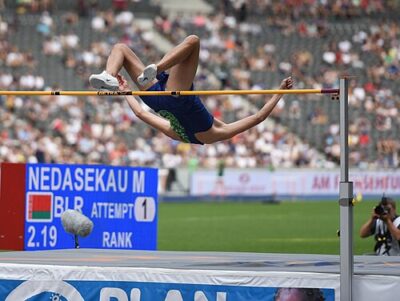
Maksim Nedasekau is a Belarusian high jumper. Born January 21, 1998, in Vitebsk. Educated at Belarusian State University of Physical Culture. Awards include Order of Honor and Person of the Year of Vitebsk Region.
Facts
9 facts · 1 confirmed by two sources · 0 cited · 8 from one source
Where this comes from
Papalocal keeps its own record. It started from these sources; what each one said is kept here as it was copied, so a change on their side never changes this page by itself. Tap one to read its version.
What Wikidata says · copied November 18, 2026 · revision 2539921552
- Described as
- Belarusian high jumper (1998-)
- Other names
- Maksim Niedasiekaŭ, Maksim Nedosekov, Maksim Yuryevich Nedasekau
- Born
- January 21, 1998 · 1 reference
- Born in
- Vitebsk · 1 reference
- Citizen of
- Belarus
- Occupation
- high jumper
- Education
- Belarusian State University of Physical Culture
- Sport
- athletics
- Awards
- Order of Honor (2022); Person of the Year of Vitebsk Region (2018)
- Height
- 1.93 m (6 ft 4 in)
- Wikipedias with a page
- 21
Wikidata item Q31030755 (wikidata.org/wiki/Q31030755), public domain (CC0). Copied November 18, 2026.
What Wikipedia says · copied November 18, 2026 · revision 1364218595
Maksim Yuryevich Nedasekau (Belarusian: Максім Юр’евіч Недасекаў; born 21 January 1998) is a Belarusian athlete specialising in the high jump and praporshchik of the Sports Committee of the Armed Forces of Belarus. He was the bronze medallist at the 2020 Olympic Games. He also won the gold medals at the 2021 European Indoor Championships, 2019 European U23 Championships and 2017 European U20 Championships.
In 2019, he won the silver medal in the team event at the 2019 European Games.
His personal bests are 2.37 metres outdoors (2020 Olympic Games) and 2.37 metres indoors (Toruń 2021).
- Born, in its opening lines
- January 21, 1998
From the Wikipedia article “Maksim Nedasekau” (en.wikipedia.org/wiki/Maksim_Nedasekau), by its contributors, under CC BY-SA 4.0 (creativecommons.org/licenses/by-sa/4.0/). Copied November 18, 2026; not changed.
Confirmed Two sources agree. Cited One source, and it names where it got it. One source One source, without a reference of its own. Sources disagree The sources disagree. We show the best-supported value and keep theirs below.
