
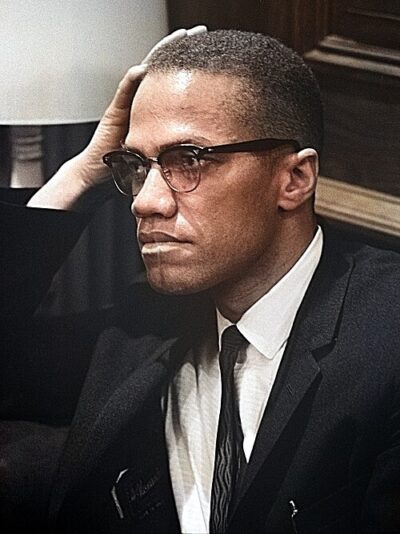
Malcolm X
Malcolm X was an American Black rights activist. Born May 19, 1925, in Omaha. Died February 21, 1965, in Manhattan. Awards include Anisfield-Wolf Book Awards.
Facts
32 facts · 2 confirmed by two sources · 10 cited · 20 from one source
Where this comes from
Papalocal keeps its own record. It started from these sources; what each one said is kept here as it was copied, so a change on their side never changes this page by itself. Tap one to read its version.
What Wikidata says · copied November 13, 2026 · revision 2558145126
- Described as
- American Black rights activist (1925–1965)
- Other names
- El-Hajj Malik El-Shabazz, Malachi Shabazz, Malcolm Shabazz, Malik El-Shabazz, Malcolm Little
- Born
- May 19, 1925 · 11 references
- Died
- February 21, 1965 · 11 references
- Born in
- Omaha · 1 reference
- Died in
- Manhattan · 2 references
- Buried in
- Ferncliff Cemetery · 1 reference
- Cause of death
- gunshot wound · 1 reference
- Name at birth
- Malcolm Little
- Citizen of
- United States
- Occupation
- politician · 1 reference; autobiographer; political activist; human rights defender · 1 reference; Muslim minister · 1 reference; imam · 1 reference; religious leader; civil rights advocate · 1 reference
- Awards
- Anisfield-Wolf Book Awards (1966)
- Field
- human rights protection · 1 reference
- Spouse
- Betty Shabazz (1958–) · 2 references
- Children
- Malikah Shabazz; Ilyasah Shabazz; Qubilah Shabazz; Gamilah Lumumba Shabazz; Attallah Shabazz; Malaak Shabazz
- Father
- Earl Little
- Mother
- Louise Little
- Siblings
- Reginald Little · 1 reference; Ella Little-Collins
- Religion
- Islam (1948–); Nation of Islam (1948–1964)
- Lived in
- Malcolm X—Ella Little-Collins House · 1 reference
- Wikipedias with a page
- 135
Wikidata item Q43303 (wikidata.org/wiki/Q43303), public domain (CC0). Copied November 13, 2026.
What Wikipedia says · copied November 13, 2026 · revision 1384980599
Malcolm X (born Malcolm Little, later el-Hajj Malik el-Shabazz; May 19, 1925 – February 21, 1965) was an African American revolutionary, civil rights leader, and Muslim minister who was a prominent figure during the civil rights movement until his assassination in 1965. He discovered the new religious movement the Nation of Islam while in prison and served as a spokesperson from 1952 until he transitioned to Sunni Islam in 1964. He is often regarded as one of the most significant Muslim figures in the history of the United States. A controversial figure accused of preaching violence, Malcolm X is also a celebrated figure within the African American community for his pursuit of racial justice and equality.
Malcolm spent his adolescence living in a series of foster homes and with various relatives, after his father's death and his mother's hospitalization. In 1946, he was sentenced to eight to ten years in prison for larceny and burglary. While there, he joined the Nation of Islam, adopting the name Malcolm X to symbolize his unknown African ancestral surname while discarding "the white slavemaster name of 'Little'", and after his parole in 1952, he quickly became one of the organization's most influential leaders. He was the public face of the organization for 12 years, advocating black empowerment and separation of Black and white Americans, as well as criticizing Martin Luther King Jr. and the mainstream civil rights movement for its emphasis on non-violence and racial integration. Malcolm X also expressed pride in some of the Nation's social welfare achievements such as its free drug rehabilitation program. From the 1950s onward, Malcolm X was subjected to surveillance by the Federal Bureau of Investigation (FBI).
In the 1960s, Malcolm X began to grow disillusioned with the Nation of Islam and its leader Elijah Muhammad. He subsequently embraced Sunni Islam and the mainstream civil rights movement after completing the Hajj to Mecca and became known as "el-Hajj Malik el-Shabazz", which roughly translates to "The Pilgrim Malcolm the Patriarch". After a brief period of travel across Africa, he publicly renounced the Nation of Islam and founded the Islamic MMI and the Pan-African Organization of Afro-American Unity (OAAU). Throughout 1964, his conflict with the Nation of Islam intensified and he was repeatedly sent death threats. On February 21, 1965, he was assassinated in New York City. Three Nation of Islam members were charged with the murder and given indeterminate life sentences. In 2021, two of the convictions were vacated. Speculation about the assassination and whether it was conceived or aided by leading or additional members of the Nation, or with law enforcement agencies, has persisted for decades.
Malcolm X was posthumously honored with Malcolm X Day on which he is commemorated in various cities across the United States, with Berkeley and Oakland city offices and schools closed. Hundreds of streets and schools in the United States have been renamed in his honor, while the Audubon Ballroom, the site of his assassination, was partly redeveloped in 2005 to accommodate the Malcolm X and Dr. Betty Shabazz Memorial and Educational Center.
Malcolm X's ideas were an important influence on the Black power movement. His autobiography, on which he collaborated with Alex Haley, was published posthumously in 1965.
- Born, in its opening lines
- May 19, 1925
- Died, in its opening lines
- February 21, 1965
From the Wikipedia article “Malcolm X” (en.wikipedia.org/wiki/Malcolm_X), by its contributors, under CC BY-SA 4.0 (creativecommons.org/licenses/by-sa/4.0/). Copied November 13, 2026; not changed.
Confirmed Two sources agree. Cited One source, and it names where it got it. One source One source, without a reference of its own. Sources disagree The sources disagree. We show the best-supported value and keep theirs below.
