
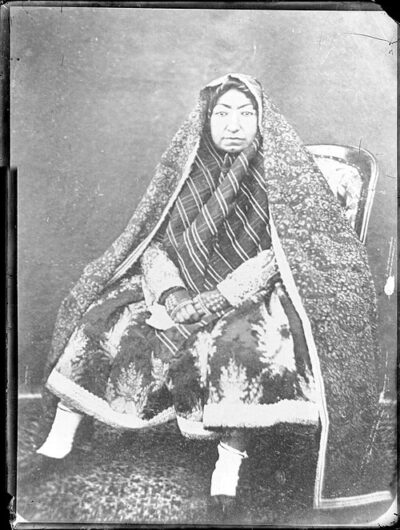
Malek Jahan Khanom
Malek Jahan Khanom was a Regent of Persia, Qajar queen mother and princess. Born February 26, 1805, in Tehran. Died April 2, 1873, in Tehran.
Facts
11 facts · 2 confirmed by two sources · 0 cited · 9 from one source
Where this comes from
Papalocal keeps its own record. It started from these sources; what each one said is kept here as it was copied, so a change on their side never changes this page by itself. Tap one to read its version.
What Wikidata says · copied November 18, 2026 · revision 2489825456
- Described as
- Regent of Persia, Qajar queen mother and princess (1805-1873)
- Other names
- Mahd-e Olia, Mahd-e Olya
- Born
- February 26, 1805
- Died
- April 2, 1873
- Born in
- Tehran
- Died in
- Tehran
- Citizen of
- Qajar Iran
- Occupation
- royal consort
- Spouse
- Mohammad Shah Qajar
- Children
- Naser al-Din Shah Qajar; Ezzat ed-Dowleh
- Father
- Mohammad Qassem Khan Qajar Qovanlou
- Siblings
- Musa Khan Qajar
- Wikipedias with a page
- 22
Wikidata item Q1115569 (wikidata.org/wiki/Q1115569), public domain (CC0). Copied November 18, 2026.
What Wikipedia says · copied November 18, 2026 · revision 1382852579
Malek Jahan Khanom (Persian: ملکجهان خانم; 26 February 1805 – 2 April 1873) was one of the wives of Mohammad Shah Qajar and the mother of Naser al-Din Shah Qajar. She was the de facto regent of Iran for one month, from 5 September until 5 October in 1848, between the death of her husband and the accession of her son. She is regarded as one of the important court figures of the Qajar era. She was the most powerful and influential woman of the Qajar dynasty.
During the reign of Naser al-Din Shah, the supervision of all the women of the Qajar harem was under Mahd-e Olya, and she carried out most of the harem's important affairs. Correspondence with foreign empresses and the wives of ambassadors, as well as hosting female foreign guests who visited the harem, was Malek Jahan Khanom's responsibility. She also played an important role in the appointment of governors and ministers. After her death, the supervision of the royal harem was entrusted to Anis al-Dowleh, a wife of Naser al-Din Shah.Moʿayyer al-Mamalek writes: Mahd-e Olya had an immense and splendid household. My grandmother, Taj al-Dowleh, the first formal wife of Naser al-Din Shah after his accession, used to tell me that four high-ranking eunuchs and twenty personal attendants were always with Mahd-e Olya; dressed in exquisite and elegant garments, so honored and respected that the women of the inner court were jealous of them and flattered them to gain their attention. In her pantry and dining hall, there were so many jeweled hookahs, tea and coffee cups, trays, sherbet bowls, spoons, and gold and silver utensils that even in the shops of the most reputable goldsmiths, such a collection could not be found. Mahd-e Olya's table was always colorful and abundant; every day and night, sixty to seventy sons and daughters of Fath-Ali Shah and other prominent women of the court would sit at her table. The Shah's mother's special washbasin and basin were made of jewel-encrusted gold, and the other washbasins were made of enameled silver. She had a private bath, whose dressing rooms, treasuries, walls, and floors were decorated with the finest marble, and all the bath utensils were made of turquoise-inlaid silver. Twice a week, she would go to the bath in the mornings. Each time, the maidservants stood in two lines from her room to the bath, holding up a long curtain—woven from lengths of shawl—so that no one could see the Shah's mother in her nightgown.
One European traveler wrote about Mahd-e Olya's influence and power: "The Queen Mother, known at court as Valedeh, possesses such authority and prestige that she plays a decisive role, particularly in appointing governors, selecting ministers, and even in the Shah's marriages. Her affairs are always the main subject of rumors and conversations among the townspeople".
- Born, in its opening lines
- February 26, 1805
- Died, in its opening lines
- April 2, 1873
From the Wikipedia article “Malek Jahan Khanom” (en.wikipedia.org/wiki/Malek_Jahan_Khanom), by its contributors, under CC BY-SA 4.0 (creativecommons.org/licenses/by-sa/4.0/). Copied November 18, 2026; not changed.
Confirmed Two sources agree. Cited One source, and it names where it got it. One source One source, without a reference of its own. Sources disagree The sources disagree. We show the best-supported value and keep theirs below.
