
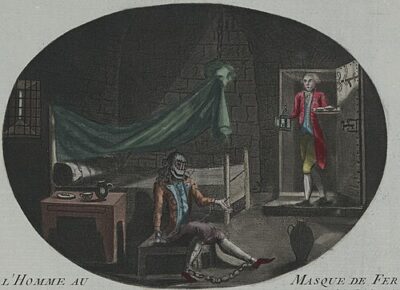
man in the Iron Mask
man in the Iron Mask was the 17th century prisoner, among the most famous in French history. Born 1640s. Died November 19, 1703, in Paris.
Facts
5 facts · 1 confirmed by two sources · 0 cited · 4 from one source
Where this comes from
Papalocal keeps its own record. It started from these sources; what each one said is kept here as it was copied, so a change on their side never changes this page by itself. Tap one to read its version.
What Wikidata says · copied November 16, 2026 · revision 2569041627
- Described as
- 17th century prisoner, among the most famous in French history
- Other names
- Iron Mask, Eustache Dauger, The Man in the Iron Mask
- Born
- 1640s
- Died
- November 19, 1703 · 3 references
- Died in
- Paris
- Citizen of
- Kingdom of France
- Occupation
- prisoner
- Wikipedias with a page
- 39
Wikidata item Q72296 (wikidata.org/wiki/Q72296), public domain (CC0). Copied November 16, 2026.
What Wikipedia says · copied November 16, 2026 · revision 1386076383
The Man in the Iron Mask (French: L'Homme au Masque de Fer; died 19 November 1703) was an unidentified prisoner of state during the reign of Louis XIV of France (1643–1715). The strict measures taken to keep his imprisonment secret resulted in a long-lasting legend about his identity. Warranted for arrest on 19 July 1669 under the name of "Eustache Dauger", he was apprehended near Calais on 28 July, incarcerated on 24 August, and held for 34 years in the custody of Bénigne Dauvergne de Saint-Mars in four successive French prisons, including the Bastille. He died there on 19 November 1703, and his burial certificate bore the name of "Marchioly", leading several historians to conclude that the prisoner was Italian diplomat Ercole Antonio Mattioli.
His true identity remains a mystery, even though it has been extensively debated by historians, and various theories have been expounded in numerous books, articles, poems, plays, and films. During his lifetime, it was rumoured that he was a Marshal of France or a President of Parlement, the Duke of Beaufort, or a son of Oliver Cromwell, and some of these rumours were initiated by Saint-Mars himself. Among the oldest theories is one proposed by French philosopher and writer Voltaire, who claimed in his Questions sur l'Encyclopédie (1771) that the prisoner was an older, illegitimate brother of Louis XIV. Other writers believed that he was the King's twin or younger brother. In all, more than 50 candidates, real and hypothetical, have been proposed by historians and other authors aiming to solve the mystery.
What little is known about the prisoner is based on contemporaneous documents uncovered during the 19th century, mainly some of the correspondence between Saint-Mars and his superiors in Paris, initially Louvois, Louis XIV's secretary of state for war. These documents show that the prisoner was labelled "only a valet" and that he was jailed for "what he was employed to do" before his arrest, and for "what he saw." Legend has it that no one ever saw his face, as it was hidden by a mask of black velvet cloth, later misreported by Voltaire as an iron mask. Official documents reveal, however, that the prisoner was made to cover his face only when travelling between prisons after 1687, or when going to prayers within the Bastille in the final years of his incarceration; modern historians believe that the measure was imposed by Saint-Mars solely to increase his own prestige, thus causing persistent rumours to circulate about this seemingly important prisoner.
In 1932, French historian Maurice Duvivier proposed that the prisoner was Eustache Dauger de Cavoye, a nobleman associated with several political scandals of the late 17th century. This solution, however, was disproved in 1953 when previously unpublished family letters were discovered by French historian Georges Mongrédien, who concluded that the enigma remained unsolved.
He has been the subject of many works of fiction, most prominently Alexandre Dumas' 1850 novel The Vicomte of Bragelonne: Ten Years Later—the final installment of his D'Artagnan saga—which portrays the prisoner as Louis XIV's identical twin. In 1840, Dumas had first presented a review of the popular theories about the prisoner extant in his time in the chapter "L'homme au masque de fer," published in the eighth volume of his non-fiction Crimes Célèbres. This approach was adopted by many subsequent authors, and speculative works have continued to appear on the subject.
- Died, in its opening lines
- November 19, 1703
From the Wikipedia article “Man in the Iron Mask” (en.wikipedia.org/wiki/Man_in_the_Iron_Mask), by its contributors, under CC BY-SA 4.0 (creativecommons.org/licenses/by-sa/4.0/). Copied November 16, 2026; not changed.
Confirmed Two sources agree. Cited One source, and it names where it got it. One source One source, without a reference of its own. Sources disagree The sources disagree. We show the best-supported value and keep theirs below.
