
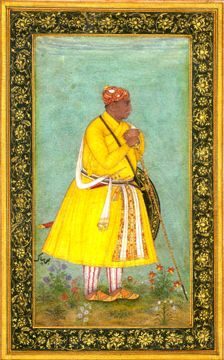
Man Singh I
Man Singh I was a Kacchwaha King of Amber, later known as Jaipur. Born December 21, 1550, in Amber. Died July 6, 1614, in Achalpur.
Facts
7 facts · 2 confirmed by two sources · 0 cited · 5 from one source
Where this comes from
Papalocal keeps its own record. It started from these sources; what each one said is kept here as it was copied, so a change on their side never changes this page by itself. Tap one to read its version.
What Wikidata says · copied November 18, 2026 · revision 2521276917
- Described as
- Kacchwaha King of Amber, later known as Jaipur
- Other names
- Raja Man Singh
- Born
- December 21, 1550
- Died
- July 6, 1614
- Born in
- Amber
- Died in
- Achalpur
- Occupation
- monarch
- Father
- Bhagwant Das
- Religion
- Hinduism
- Wikipedias with a page
- 20
Wikidata item Q3630505 (wikidata.org/wiki/Q3630505), public domain (CC0). Copied November 18, 2026.
What Wikipedia says · copied November 18, 2026 · revision 1386413560
Raja Man Singh I (21 December 1550 – 6 July 1614) was the 24th Kachawaha ruler of the Kingdom of Amber from 1589 to 1614. For the Mughals, he also served as the foremost imperial Subahdar of Bihar Subah from 1587 to 1594, then for Bengal Subah for three terms from 1595 to 1606 and the Subahdar of Kabul Subah from 1585 to 1586. He served in the imperial Mughal Army under Emperor Akbar. Man Singh fought sixty-seven important battles in Kabul, Balkh, Bukhara, Bengal and Central and Southern India. He was well versed in the battle tactics of both the Rajputs as well as the Mughals. He is commonly considered to be one of the Navaratnas, or the nine (nava) gems (ratna) of the royal court of Akbar.
- Born, in its opening lines
- December 21, 1550
- Died, in its opening lines
- July 6, 1614
From the Wikipedia article “Man Singh I” (en.wikipedia.org/wiki/Man_Singh_I), by its contributors, under CC BY-SA 4.0 (creativecommons.org/licenses/by-sa/4.0/). Copied November 18, 2026; not changed.
Confirmed Two sources agree. Cited One source, and it names where it got it. One source One source, without a reference of its own. Sources disagree The sources disagree. We show the best-supported value and keep theirs below.
