
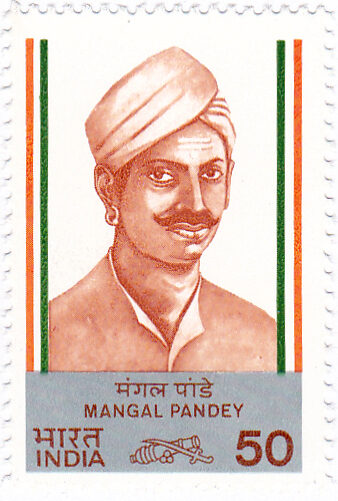
Mangal Pandey
Mangal Pandey was an India's First Freedom Fighter. Born July 19, 1827, in Ballia. Died April 8, 1857, in Barrackpore.
Facts
12 facts · 1 confirmed by two sources · 8 cited · 3 from one source
What’s different
- Died: we show April 8, 1857 (Confirmed). Wikidata also lists April 7, 1857
Where this comes from
Papalocal keeps its own record. It started from these sources; what each one said is kept here as it was copied, so a change on their side never changes this page by itself. Tap one to read its version.
What Wikidata says · copied November 16, 2026 · revision 2517709489
- Described as
- India's First Freedom Fighter (1827–1857)
- Born
- July 19, 1827 · 2 references
- Died
- April 7, 1857; April 8, 1857 · 1 reference
- Born in
- Ballia
- Died in
- Barrackpore · 1 reference
- Cause of death
- hanging to death · 1 reference
- Citizen of
- British Empire · 1 reference
- Occupation
- military personnel · 1 reference; resistance fighter · 1 reference; freedom fighter · 1 reference; soldier · 1 reference
- Religion
- Hinduism
- Military rank
- soldier · 1 reference
- Wikipedias with a page
- 37
Wikidata item Q382027 (wikidata.org/wiki/Q382027), public domain (CC0). Copied November 16, 2026.
What Wikipedia says · copied November 16, 2026 · revision 1381482351
Mangal Pandey (died 8 April 1857) was an Indian soldier who played a key role in the events that led to the Indian Rebellion of 1857, which resulted in the dissolution of the East India Company and the beginning of the British Raj through the Government of India Act 1858. He was a sepoy in the 34th Regiment of the Bengal Native Infantry. In 1984, the Republic of India issued a postage stamp in his memory. His life and actions have also been portrayed in several Indian cinematic productions.
- Died, in its opening lines
- April 8, 1857
From the Wikipedia article “Mangal Pandey” (en.wikipedia.org/wiki/Mangal_Pandey), by its contributors, under CC BY-SA 4.0 (creativecommons.org/licenses/by-sa/4.0/). Copied November 16, 2026; not changed.
Confirmed Two sources agree. Cited One source, and it names where it got it. One source One source, without a reference of its own. Sources disagree The sources disagree. We show the best-supported value and keep theirs below.
